Eduard vs Tamiya vs Great Wall Hobby & Kinetic: Best 1/48 Jets & Props

Eduard vs. Tamiya vs. Great Wall Hobby & Kinetic: Who Makes the Best 1/48 WWII & Modern Fighter Kits Right Now? (2026 Bench Guide)
If you drop $70 to $110 on a modern 1/48 scale aircraft kit today, what you get inside the box depends entirely on the philosophy of the engineering team that cut the steel molds. Open a modern Tamiya box, and you get parts engineered so tightly that you could practically throw a bottle of cement into the box, give it a shake, and pull out a finished fuselage—yet the wings have almost zero recessed rivet lines and no photo-etch seatbelts. Open an Eduard ProfiPACK, and you are greeted by thousands of microscopic recessed rivets, pre-painted brass instrument panels, and die-cut canopy masks for $45—provided you don’t let a single drop of primer touch the wing-root mating surfaces.
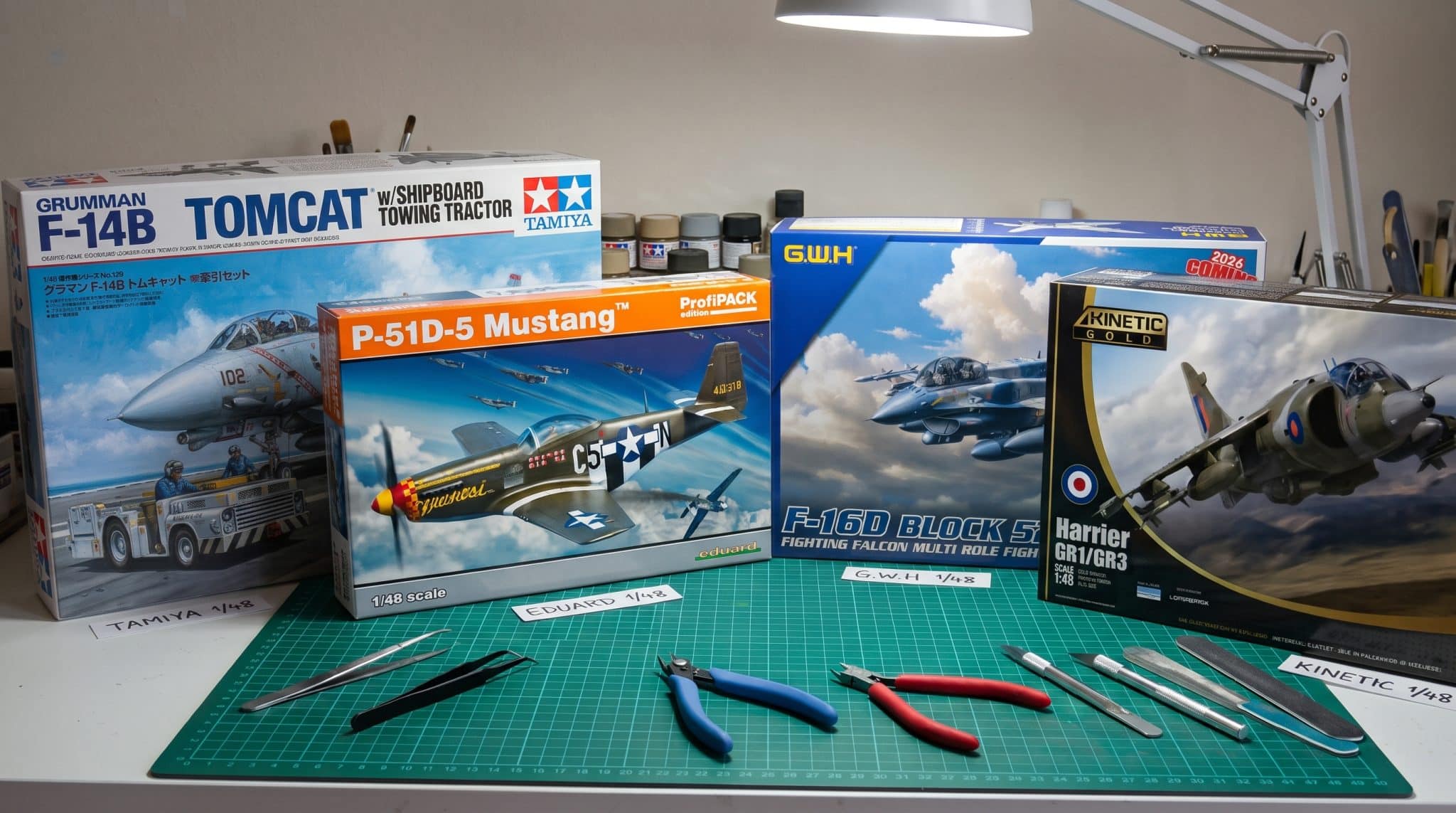
When you line up an Eduard vs Tamiya vs Great Wall Hobby 1/48 (and Kinetic Gold) comparison on the workbench, there is no single “winner” across every aircraft type. Whether you are eyeing the newly announced Tamiya 1/48 F-14B Tomcat (#61129) & Border 1/35 Leopard 2A8, building twin-seat Vipers from our Great Wall Hobby Announces 1/48 F-16D Block 52+ Export Version (L4837) and F-16V Block 70 vs Block 52+: Key Visual Differences & Scale Model Guide coverage, or stepping down from the big-scale Kotare 1/32 Hurricane Mk.I (#K32015), Eduard P-51B & ICM MiG-25PD Guide, here is how the Big Four 1/48 aircraft makers actually behave on the desk.
Disclosure: Hobbyzero is reader-supported. If you pick up kits or tools through our links, we may earn a small coffee-fund commission at no extra cost to you.
⚡ The Real-World Bench Summary (No Marketing Fluff)
- Tamiya (The Stress-Free Fit King): Unbeatable structural engineering, keyed wing spars, and zero-putty seams (especially on their 1/48 F-14, F-4B, F-35, and P-38). The trade-off? Minimal surface riveting on WWII props, thick box decals, and paper/decal seatbelts instead of photo-etch.
- Eduard (The WWII Surface Detail & Value Champion): Their post-2019 1/48 kits (Spitfire, Bf 109, Fw 190, P-51D, A6M Zero, F4F Wildcat) pack museum-grade micro-riveting, stressed skin, pre-painted photo-etch, and kabuki canopy masks into one $40–$55 ProfiPACK box.
- Great Wall Hobby / GWH (The Heavy Twin-Jet Specialist): If you want a 1/48 F-15E Strike Eagle, Su-27/Su-35 Flanker, MiG-29, or A-10C Warthog with one-piece slide-molded missiles and crisp surface detail, GWH is in a league of its own—though priced at a premium ($85–$120).
- Kinetic “Gold Series” (The Modern NATO & Export Jet Library): Don’t judge Kinetic by their clunky 2010 kits! Their newer “Kinetic Gold” toolings (F-16C/D/V, F-104G, Mirage 2000) use slide-molded noses and improved fit to cover modern export variants that Tamiya ignores.
1/48 Aircraft Manufacturers Compared: Fit, Detail & In-Box Extras
| Manufacturer | Fit & Engineering | Surface Rivets | In-Box Extras | Best 1/48 Kits to Buy Right Now | Link |
|---|---|---|---|---|---|
| Tamiya (Modern Toolings) | 10/10 (Foolproof) | Restrained (8/10) | Canopy Masks (Un-cut) | F-14A/B/D, F-4B, F-35A/B/C, P-38F/G/J, Spitfire Mk.I | Amazon |
| Eduard (ProfiPACK / Royal) | 8.5/10 (Tight Tolerances) | 10/10 (Micro-Riveted) | Color PE + Pre-Cut Masks | P-51B/D, A6M2/3 Zero, Bf 109G/K, Spitfire Mk.IX, F4F-4 | Amazon |
| Great Wall Hobby (GWH) | 9/10 (Complex Modular) | 9.5/10 (Crisp & Sharp) | PE + Slide-Molded Missiles | F-15C/E, Su-27UB / Su-35S, A-10C, F-14D, F-16D | Amazon |
| Kinetic (Gold Series Only) | 8/10 (Needs Dry-Fitting) | 8.5/10 (Deep Panel Lines) | PE + Huge Cartograf Sheet | F-16A/C/D/V Gold, F-104G/S Starfighter, F-5A Freedom Fighter | Amazon |
The Great Debate: Tamiya’s “Restrained” Skins vs. Eduard’s Micro-Rivets
Spend five minutes in any aviation modeling group and you will see two camps arguing over what a 1/48 WWII fighter wing should look like:
1. Why Tamiya Leaves Off Most Recessed Rivets (And Focuses on Assembly Flow)
Tamiya’s lead aircraft designers work on a strict rule: if a flush rivet on a full-size Spitfire or Mustang is 3mm wide and sanded smooth at the factory, scaling it down 48 times makes it 0.06mm—practically invisible from six feet away. Instead of covering their 1/48 P-38 Lightning or Ki-61 Tony in thousands of pinholes, Tamiya invests their tooling budget into blind alignment keys and step-free seams.
-
For example, on Tamiya’s 1/48 P-38F/G/J (#61120/#61123), the twin tail booms lock into a one-piece reinforced main wing spar with metal ball weights already pre-measured for the nose—making it physically impossible to glue the tail crooked!
-
Similarly, on their 1/48 F-35C Lightning II (#61127) and F-14 Tomcat series, Tamiya splits the fuselage joints right along real-life maintenance panel lines so you almost never have to touch a sanding stick or mix up a batch of DIY Sprue Goo.
2. Why Weathering Fans Prefer Eduard’s Surface Texture
Now look at an Eduard 1/48 A6M2 Zero, Spitfire Mk.I/IX, or P-51D Mustang sitting right next to a Tamiya kit under an airbrush lamp. Even if full-size rivets are technically tiny, in 1/48 scale a dead-smooth plastic wing can look slightly toy-like once painted in single-color Olive Drab or IJN Green.
-
Eduard tools their post-2019 molds with whisper-fine recessed rivet rows and subtle “oil-canning” (stressed metal ripples between the wing ribs).
-
When you prime an Eduard wing with Mr. Finishing Surfacer 1500 thinned 1:1.5 with Leveling Thinner and run an enamel pin-wash from our Safe Panel Lining Guide or an oil filter from our Oil Paint Rendering vs Enamel Washes Guide across those micro-rivets, the surface comes alive with instant visual depth—without you spending 15 hours running a manual rivet wheel over the plastic!
The Big Four Breakdown: Honest Workbench Pros, Cons & Quirks
1. Tamiya 1/48 Masterpiece Series (F-14A/B/D, F-4B Phantom, F-35A/B/C, P-38J) — The “Zero-Putty” Engineering King
If you have a demanding job, limited bench time, and just want a build where every single bulkhead clicks together on the first try, modern 1/48 Tamiya kits are worth every penny. Their #61121 F-4B Phantom II and #61114/#61129 F-14A/B Tomcat solved forty years of notoriously awful multi-part jet intake seams by engineering slide-molded trunks that hide the joints completely out of sight.
✅ Why We Love Tamiya on the Bench:
- Best engineering in the hobby—wing roots, intakes, and multi-piece engine nozzles fit with zero filler putty
- Crystal-clear, distortion-free canopies and foolproof instruction callouts
- Rock-hard grey styrene responds brilliantly to single-blade nippers and capillary cements
⚠️ Watch Out For:
- Included canopy masks are printed on un-cut paper—you have to slice every tiny curve out yourself with a fresh #11 blade!
- Thick in-box decals require Tamiya Mark Fit Strong / Super Strong and a hot damp swab to conform
👉 Check prices on Tamiya 1/48 F-14, F-4B, F-35 & P-38 Kits on Amazon
2. Eduard 1/48 ProfiPACK Series (P-51B/D, Spitfire, Bf 109, Fw 190, Zero, Wildcat) — Unbeatable Detail per Dollar
Suppose you buy a competing WWII fighter kit for $45, then spend $18 on a photo-etch cockpit upgrade, $12 on pre-cut kabuki canopy masks, and $15 on a 6-option aftermarket decal sheet. You just spent $90. Or, you buy an Eduard 1/48 ProfiPACK for $42, and every single one of those upgrades is already sitting inside the box on day one—alongside the best surface riveting in 1/48 scale.
✅ Why We Love Eduard on the Bench:
- ProfiPACK Value: Includes pre-painted steel seatbelts, instrument panels, die-cut yellow kabuki masks, and 5 to 6 historical marking schemes
- Post-2019 new-tool molds (P-51B/D, A6M Zero, F4F Wildcat, Bf 109G/K) have eliminated the fussy multi-part engine cowlings of their older 2012 kits
- Budget-friendly Weekend Edition boxes give you the exact same plastic sprues for under $30!
⚠️ Watch Out For:
- Zero-Gap Mating Tolerances: Just like we warned in our Full-Interior Armor Guide, scrape all paint off the cockpit tub walls before closing an Eduard fuselage, or the wing roots will push outward by 0.5mm!
- Many horizontal stabilizer elevators and rudders use flat butt-joints rather than deep tabs—reinforce them with a 0.5mm brass wire pin if you pose them drooped
👉 Check prices on Eduard 1/48 ProfiPACK Aircraft Kits on Amazon
3. Great Wall Hobby / GWH (F-15C/E, Su-27 / Su-35S, A-10C, F-14D) — The Heavy Modern Jet Heavyweight
One of the worst chores in modern jet modeling is gluing together twelve two-piece AIM-120 AMRAAM and R-73 missiles, sanding out forty tiny fin seams, and accidentally snapping half the fins off. Great Wall Hobby (GWH) spoiled jet builders forever by using multi-directional slide molds to cast entire air-to-air missiles in a **single seamless piece** with paper-thin fins and hollowed-out exhaust nozzles right on the sprue!
✅ Why We Love GWH on the Bench:
- Undisputed best 1/48 F-15C/E Eagle (#L4817/#L4822), Su-27UB / Su-35S Flanker (#L4820/#L4824), and A-10C Warthog (#L4834) on the market
- One-piece slide-molded missiles, gun barrels, and exhaust cans save 10+ hours of tedious seam sanding
- Posable high-lift slats, flaps, airbrakes, and detailed radar arrays included in the box
⚠️ Watch Out For:
- High retail price ($90 to $130)—though they include weapons loads that other brands sell separately
- Instruction manuals occasionally have vague arrow placement or flipped paint callouts—always cross-check your real-world reference photos!
👉 Check prices on Great Wall Hobby (GWH) 1/48 Jet Kits on Amazon
4. Kinetic “Gold Series” (F-16C/D/V Viper, F-104G Starfighter, Mirage 2000) — Best for Modern Export & NATO Variants
If you built an early Kinetic F-16 or E-2C Hawkeye back in 2009, you probably still have nightmares about soft plastic, pebble-textured skin, and intakes that needed half a tube of putty. Starting around 2020, however, Kinetic overhauled their CAD and mold-polishing standards under the “Kinetic Gold” banner. Their new-tool 1/48 F-104G/S Starfighter (#K48089/#K48096) and New-Tool F-16A/C/D/V Gold series (#K48100/#K48102/#K48154) are worlds apart from their old kits—giving you Conformal Fuel Tanks (CFTs), Dorsal Spines, and targeting pods that Tamiya never released.
✅ Why We Love Kinetic Gold on the Bench:
- The 1/48 Kinetic Gold F-104G Starfighter is an absolute gem—better detailed and easier to build than the old Hasegawa kit
- Covers modern European, Turkish, Greek, Israeli, and Taiwanese F-16D/V Block 52+/70 variants right out of the box
- Ships with massive, world-class Cartograf decal sheets designed by top aviation artists
⚠️ Watch Out For:
- Check the Box Logo First: Make sure the box says “KINETIC GOLD” (K48100 and newer for Vipers)—avoid accidentally buying re-boxes of their 2008 first-generation F-16 molds!
- Test-fit the multi-part jet intakes and landing gear bays carefully before committing glue
👉 Check prices on Kinetic Gold Series 1/48 Jet Kits on Amazon
Quick Cheat-Sheet: Which Brand Wins Each Famous 1/48 Aircraft?
Standing in front of the hobby shop shelf trying to pick between two boxes of the same plane? Here is the rapid-fire consensus from the workbench:
-
1/48 F-14A / F-14B / F-14D Tomcat: Tamiya (#61114 / #61129 / #61118) wins for the most stress-free build in history; Great Wall Hobby (#L4828 / #L4832) wins only if you want dropped leading-edge slats, flaps, and full exhaust petals in the same box without buying Tamiya’s separate #61122 detail-up parts.
-
1/48 F-16C / F-16D Fighting Falcon: Tamiya (#61098 Block 25/32 or #61101 Block 50) is still the single-seat fit champion; Great Wall Hobby (#L4837) or Kinetic Gold (#K48102 / #K48154) wins if you want a two-seat F-16D with a dorsal spine, Conformal Fuel Tanks, or an F-16V Viper.
-
1/48 F-15C Eagle / F-15E Strike Eagle: Great Wall Hobby (GWH) wins hands down over the aging Revell and Hasegawa molds.
-
1/48 F-4B / F-4C / F-4E Phantom II: Tamiya (#61121) owns the Navy F-4B; Zoukei-Mura (SWS) and Meng (#LS-015 / #LS-017) own the slatted-wing Air Force F-4E/G (pair your Phantom with our featured Babibi Models F-4E TUrAF Stencils!).
-
1/48 P-51B/C & P-51D Mustang: Eduard (#82101 / #82171) wins on surface riveting, wheel well plumbing, and canopy options; Tamiya (#61040) is an older 1990s tooling that goes together in an afternoon for beginners on a $25 budget.
-
1/48 Spitfire Mk.I & Mk.IX: Tamiya (#61119) and Eduard (#82151) are neck-and-neck on the early Mk.I, while Eduard (#8281) is the undisputed king of the mid-war Spitfire Mk.IXc/e.
-
1/48 A6M2 / A6M3 Zero: Eduard (#82212) edges out Tamiya’s new-tool A6M3 (#61108) purely on factory stressed-skin riveting, though both are 10/10 masterpieces that spray beautifully with our Harder & Steenbeck Ultra 2024 vs Iwata Eclipse HP-CS vs PS-289 setups and ATOM by Ammo / Vallejo Airbrush Ratios.
Frequently Asked Questions (FAQ)
What is the difference between Eduard “ProfiPACK,” “Weekend Edition,” and “Overtrees”?
All three use the exact same plastic sprues inside!
-
ProfiPACK: Includes the plastic sprues, pre-painted photo-etch brass (seatbelts & instrument panels), pre-cut yellow kabuki canopy/wheel masks, and 5 to 6 decal marking options.
-
Weekend Edition: Gives you the plastic sprues and 4 full decal marking options at a lower price (~$25–$32), omitting the photo-etch brass and canopy masks so you can build it over a weekend.
-
Overtrees: Sold exclusively on Eduard’s website—just a plain white box containing the bare plastic sprues with zero decals or instructions (meant for using up the leftover marking schemes from your ProfiPACK box!).
How do I tell a new “Kinetic Gold” kit apart from an old 2008 Kinetic mold?
Look for the metallic “KINETIC GOLD” crest on the front of the box and check the kit number: for 1/48 F-16 kits, anything numbered #K48100 and higher (released from 2022 onward) uses the brand-new, high-precision CAD molds. Avoid older F-16 kit numbers in the #K48002 to #K48085 range unless you enjoy heavy sanding and puttying around the intake lip.
Why won’t the wing roots close flush on my Eduard 1/48 Spitfire or Bf 109?
Eduard designs their cockpit side walls and wheel well bulkheads with zero gap tolerance against the inside of the fuselage. If you prime and paint the outside of the cockpit tub walls before gluing them inside the fuselage, that 0.1mm layer of paint pushes the fuselage belly outward by half a millimeter—creating a step at the wing root! Always scrape the outer mating edges of the cockpit tub and wheel well ribs down to bare grey plastic, and glue the upper wings to the fuselage halves before attaching the lower wing piece if a slight gap remains.