
Why Is My Airbrush Spitting Water & Paint? 7 Quick Fixes

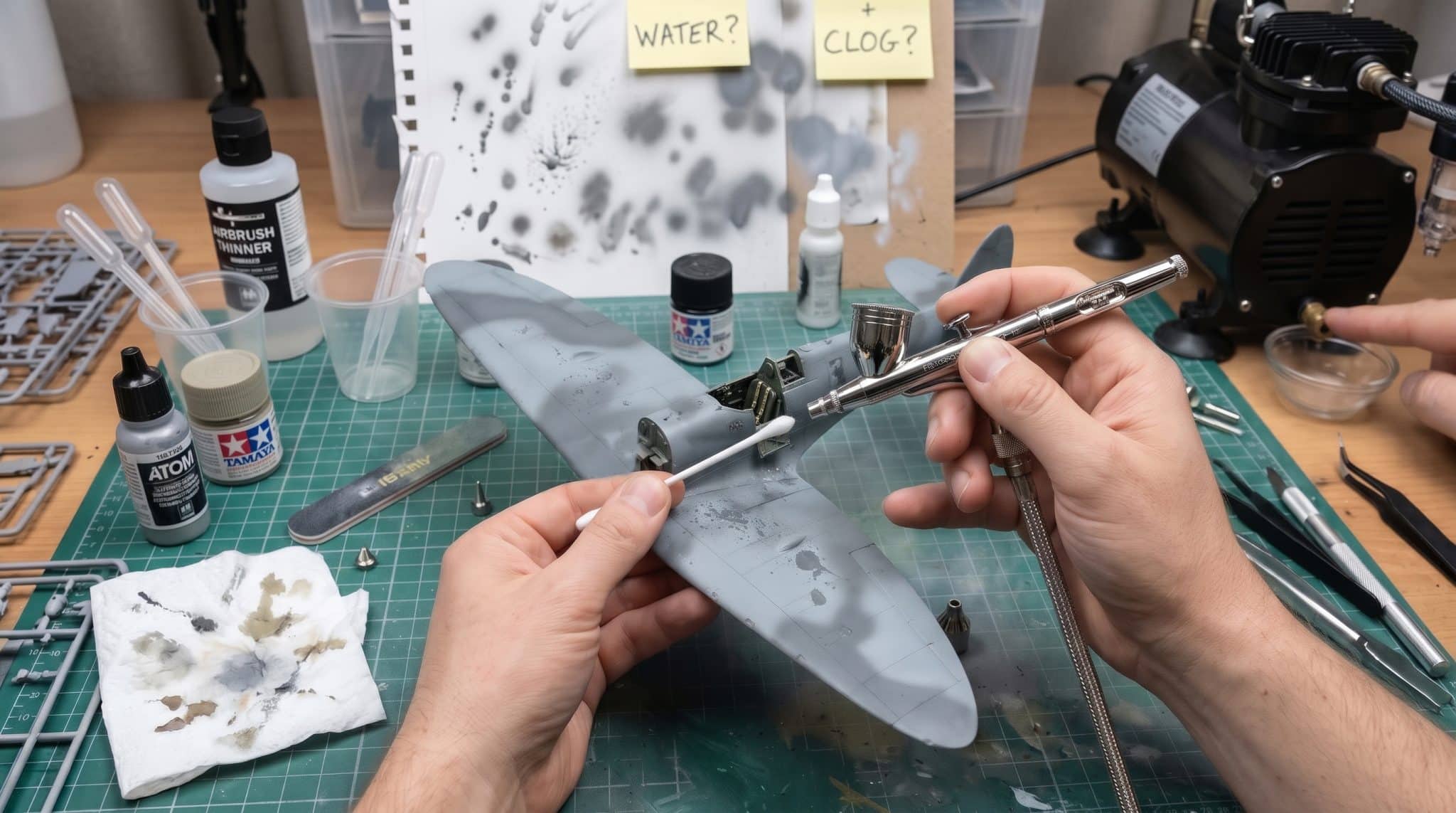
Why Is My Airbrush Spitting Water & Sputtering Paint? Real Bench Fixes (2026 Guide)
If we held a contest for the most soul-crushing moments on the scale modeling workbench, a strong contender would be this: you are sitting at your desk, dialed in on a tricky Luftwaffe camouflage line, and right in the middle of a pristine wing root, your trusty airbrush suddenly chokes and hurls a glob of dirty brown condensation straight onto your model.
Or worse, the paint cup starts boiling angrily, refusing to pull paint unless you crank your compressor up to an unworkable 35 PSI. Too many internet guides give you the generic “throw it away and buy a new one” advice. In reality, a working airbrush just needs its physics understood and its seals maintained. Whether you are dialing in ATOM by Ammo Paints or evaluating a Harder & Steenbeck Ultra 2024 vs Iwata Eclipse HP-CS, here are the real workbench causes behind airbrush spitting and sputtering—and how to fix them.
Disclosure: Hobbyzero is reader-supported. If you pick up tools or supplies through our links, we may earn a small coffee-fund commission at no extra cost to you.
⚡ The Real-World Bench Summary (No Marketing Fluff)
- Fix #1: Cool the Air Before Your Water Trap: Compressing humid air creates heat. If your water trap is bolted directly to a hot compressor, moisture slips right past it. Add a 10-foot (3m) stretch of hose *before* your water trap so the air cools and drops its moisture safely.
- Fix #2: Seal Every Threaded Joint (The Beeswax Rule): Air or paint passing through threaded joints will cause back-bubbling if there’s a micro-gap. Smearing a microscopic amount of beeswax, ChapStick, or Medea Thread Sealer on the nozzle and head threads stops air leaks cold.
- Fix #3: Manage Needle Tip-Dry: Dried acrylic crust on the needle tip acts like a dam, forcing air backward into the fluid cup. Keep a wet brush on your desk to swipe the tip.
- Fix #4: Snug Up the Rear Chuck Nut: If the rear needle chuck is loose, air pressure pushes the needle back and forth, causing erratic paint sputtering.
Airbrush Troubleshooting Matrix: Spitting Water vs. Sputtering Paint
| Symptom on the Model | Root Cause | Immediate Bench Fix |
|---|---|---|
| Water droplets / sputtering water blowing out of nozzle | Hot compressed air cooling inside the hose | Relocate your water trap downstream by adding a 10ft (3m) hose between the compressor and the trap so air cools down. |
| Bubbling / boiling paint inside the gravity cup | Needle tip-dry or air leaking past unsealed threads | Wipe needle tip with a wet brush; apply a smear of beeswax or ChapStick to head threads. |
| Erratic pulsing / sputtering paint while pulling trigger | Loose needle chuck nut or partially clogged nozzle | Tighten rear chuck nut; flush nozzle thoroughly with cleaner. |
| Paint not spraying unless pressure is cranked to 35+ PSI | Paint too thick (improper thinning ratio) | Thin paint down properly following our [Airbrush Thinning Chart](https://hobbyzero.com/how-to/how-to-thin-vallejo-citadel-tamiya-paints-for-airbrush/). |
Real-World Troubleshooting: The Fixes That Actually Work
1. Stopping Hose Condensation (The Downstream Trap Trick)
Many modelers buy a compressor, bolt a water trap directly to the hot metal outlet, and still find water spitting out their nozzle 20 minutes later. Why? Because the air is still too hot when it hits the water trap—it hasn’t had time to cool down and condense before passing through the filter.
-
The Workbench Fix: Move your regulator/water trap downstream from the compressor. Add a 10-foot (3m) plastic hose between the compressor and your water trap. Uninsulated plastic lets the hot compressed air cool down rapidly along the hose run, allowing the water to condense inside the trap before it ever reaches your airbrush hose.
2. Sealing Air Leaks on Threads (The Beeswax & ChapStick Secret)
If you are working with an airbrush that uses traditional screw-in fluid nozzles or head assemblies, a tiny microscopic gap in the threads will let compressed air slip backward into the paint channel, causing your gravity cup to bubble violently.
-
The Workbench Fix: Every threaded joint in an airbrush that air or paint passes through should be sealed. Take a tiny smear of beeswax, unflavored ChapStick, or Medea Thread Sealer and work it into the male threads before screwing your nozzle cap or head assembly back on. It acts as an instant pneumatic gasket that stops air leaks without gumming up your paint path.
3. Managing Needle Tip-Dry
As you spray acrylics, solvent evaporation builds a tiny crust on the tip of the needle. That crust acts like a dam, forcing air backward and causing the brush to spit. Keep a soft brush dampened with flow improver on your desk to swipe the needle tip clean every few minutes.
4. Snugging Up the Rear Chuck Nut
If your paint is sputtering erratically, check the tiny retaining nut at the very back of the airbrush handle. If it’s loose, air pressure pushes the needle forward and backward while you spray. Snug it up so the needle holds its position firmly.
Frequently Asked Questions (FAQ)
Why is my airbrush bubbling in the cup like boiling water?
Bubbling paint inside the cup means air is leaking backward into the fluid channel. This is caused by a partial clog at the tip (tip-dry), unsealed head threads letting air slip past, or a loose nozzle cap.
How do I keep my airbrush from spitting water without buying a new compressor?
Move your water/moisture trap further away from the compressor by adding an extra 10-foot hose segment so the air cools down and drops its moisture into the trap before reaching your hand.