
GodHand SPN-120 vs DSPIAE ST-A 3.0 vs Tamiya 74123: Bench Test

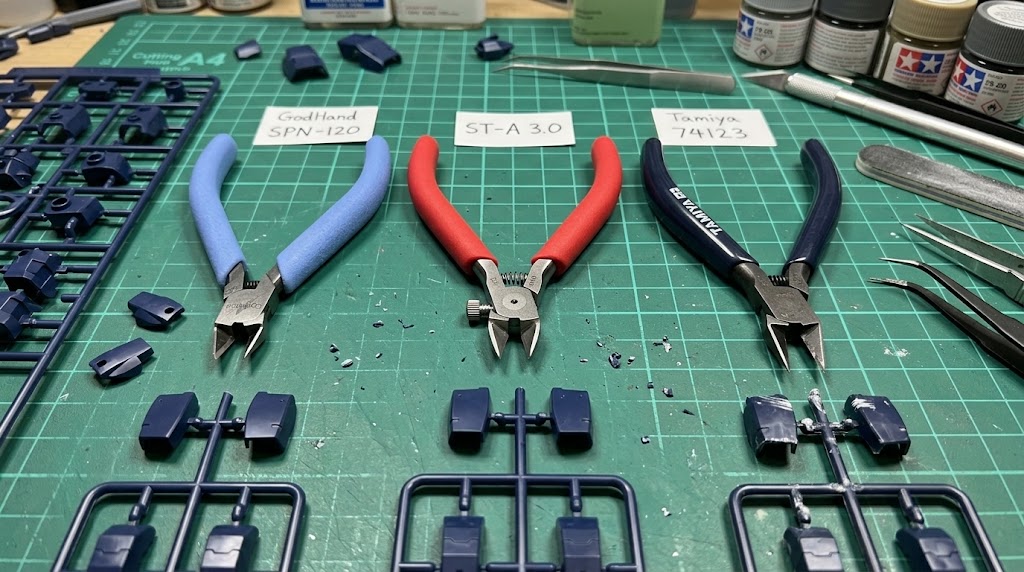
GodHand SPN-120 vs. DSPIAE ST-A 3.0 vs. Tamiya 74123: Are $60 Single-Blade Nippers Actually Worth It? (2026 Bench Test)
Every scale modeler eventually goes through the same rite of passage: someone at your local club meeting hands you a pair of blue-handled GodHand SPN-120 Ultimate Nippers, tells you to clip a piece of dark blue plastic off a sprue gate, and watches your face when the blade glides through the styrene like warm butter—without a single loud snap or an ugly white stress mark. Ten seconds later, you find yourself trying to justify why spending $60 on a pair of tiny wire cutters is a completely sensible financial decision.
When you line up a GodHand SPN-120 vs DSPIAE ST-A 3.0 vs Tamiya 74123 comparison on a real workbench, though, the question isn’t just which one cuts the cleanest. It is which one fits how you actually build—and which one won’t snap its tip off the first time you get lazy and try to chop through a thick runner. Whether you are clipping glossy mecha armor from our All Japan Model & Hobby Show 2026: Tamiya, Bandai & New Kit Reveals, removing tiny Trophy radar brackets on the Tamiya 1/48 F-14B Tomcat (#61129) & Border 1/35 Leopard 2A8, or freeing delicate cockpit tubing on the Kotare 1/32 Hurricane Mk.I (#K32015), Eduard P-51B & ICM MiG-25PD, here is how single-blade and double-blade nippers actually behave on the bench.
Disclosure: Hobbyzero is reader-supported. If you pick up tools through our links, we may earn a small coffee-fund commission at no extra cost to you.
⚡ The Real-World Bench Summary (No Marketing Fluff)
- You Need Two Nippers, Not One: A single-blade nipper (GodHand or DSPIAE) is a finishing scalpel, not a garden lopper. Always use a tough, double-blade workhorse (like the Tamiya 74123) to clip the part off the thick sprue tree, then use your single-blade nipper strictly to shave off the remaining 1mm nub.
- Why Single-Blade Cutters Don’t Leave White Marks: Standard double-blade nippers pinch plastic from both sides until the center snaps under tension—stretching the polymer chains and turning them white. Single-blade nippers use one paper-thin razor blade that slices against a flat metal “chopping board” anvil.
- GodHand SPN-120 vs. DSPIAE ST-A 3.0: The GodHand SPN-120 still wins by about 5–10% on pure effortless “butter cut” feel because its blade spine is ground thinner, but the DSPIAE ST-A 3.0 gives you 90% of the cut quality for roughly half the price—plus an adjustable stopper screw and a hard case.
- Never Touch Clear Plastic or Thick Runners: Clear polystyrene is brittle like hard glass candy. Using a GodHand or DSPIAE on clear canopy sprues or runners thicker than 2.5mm is the #1 reason modelers snap the blade tip off!
Single-Blade vs. Double-Blade Bench Comparison
| Nipper Model | Blade Geometry | Nub Stress Whiteness | Actual Job on the Workbench | Link |
|---|---|---|---|---|
| GodHand SPN-120 Ultimate Nipper 5.0 | Ultra-Thin Single Blade + Anvil | Virtually Zero (10/10) | Final flush nub shaving on dark Gunpla & tiny 1/35 parts | Amazon |
| DSPIAE ST-A 3.0 Single-Blade Nipper | Single Blade + Anvil (With Stopper) | Minimal (9/10) | Best value single-blade finisher; slightly sturdier spine | Amazon |
| Tamiya #74123 Sharp Pointed Side Cutter | Precision Slim Double-Blade | Low-Medium (7.5/10) | The indestructible daily workhorse for primary sprue cuts | Amazon |
| GodHand PN-125 Blade One Nipper | Thicker Single Blade + Anvil | Low (8.5/10) | More durable beginner alternative to the fragile SPN-120 | Amazon |
| Raser / DSPIAE Tempered Glass Nano File | 10,000-Grit Equivalent | Polishes Smooth | Erases the final 0.1mm gate shadow without scratching plastic | Amazon |
How the “Two-Cut Method” Saves Your $60 Nippers from Snapping
If you search Reddit or Facebook modeling groups for “broken GodHand,” you will find hundreds of tragic photos of snapped blades. Almost every single one of those accidents happened for the exact same reason: wrist torque and thick runners.
Because a single-blade nipper has one ultra-thin, high-carbon steel cutting edge (~58 HRC hardness), it has zero side-to-side flex. If you stick the tip of a GodHand SPN-120 directly into a tight corner on a thick sprue frame and twist your wrist even two degrees while squeezing—ping!—the tip shoots across the room into the carpet monster.
Here is the Two-Cut Routine that keeps single-blade cutters alive for years:
-
Cut #1 (The Heavy Lifter): Use a sturdy double-blade cutter—like the Tamiya #74123 or even an old $12 pair of flush cutters—to clip the part off the runner tree, leaving a 1mm to 1.5mm stub of gate sticking out of the part. Why? Because when a part is still attached to three points on a rigid runner frame, cutting one gate makes the plastic spring sideways and twist your blade.
-
Cut #2 (The Single-Blade Shave): Now that the part is sitting loose in your hand with zero tension on it, rest the flat blunt anvil side of your GodHand SPN-120 or DSPIAE ST-A 3.0 flush against the edge of the part, and gently squeeze the thin cutting blade through that remaining 1mm nub using slow, even finger pressure. No twisting, no snapping, and the gate vanishes cleanly.
(Note: Do you prime and paint 100% of your military kits using an indoor setup from our Quietest Airbrush Compressors & Portable Spray Booths for Apartments and our How to Thin Vallejo, Citadel & Tamiya Paints for Airbrush (2026 Chart)? If you are covering everything in primer anyway, a tiny white stress mark inside the plastic won’t show under paint! Even on painted armor builds, though, single-blade nippers are a lifesaver when clipping razor-thin 1/35 grab handles, antenna masts, and periscope guards that normal double-blade cutters bend or snap in half.)
The Big 3 Nippers Tested on the Bench (Honest Pros & Cons)
1. GodHand SPN-120 Ultimate Nipper 5.0 — Still the Unbeaten King of the “Butter Cut”
Forged and hand-sharpened in Tsubame-Sanjo, Japan, the GodHand SPN-120 is the tool that started the single-blade craze. What sets it apart from cheaper clones isn’t just sharpness—it is how paper-thin the back spine of the cutting blade is ground. Because the wedge of metal passing through the plastic is so narrow, it doesn’t wedge the two halves of the sprue gate apart, meaning dark blue, black, and red plastic stays completely stress-free.
✅ Why We Use It:
- Slices through 1mm polystyrene nubs with zero resistance—genuinely feels like cutting soft cheese
- Prevents delicate 1/35 tank tie-downs, periscope guards, and 1/72 landing gear struts from snapping when clipped
- Cuts nub cleanup and hobby knife paring time in half on high-part-count builds
⚠️ Watch Out For:
- Fragile if abused—never cut clear plastic, ABS rods thicker than 2mm, or brass wire!
- High-carbon steel will develop surface rust spots in humid rooms if you don’t wipe it with a drop of sewing machine oil every couple of months
2. DSPIAE ST-A 3.0 Single-Blade Nipper — 90% of the Performance for Half the Price
If the idea of spending $60 on a fragile nipper makes your eye twitch, the red-and-black DSPIAE ST-A 3.0 is the smartest compromise on the market. While the cutting blade is just a hair thicker than the GodHand SPN-120 (giving you about 90% of that effortless glide), that extra fraction of a millimeter actually makes the DSPIAE slightly less terrifying to use every day. Plus, DSPIAE includes a hard storage case, a hex wrench for the adjustable limit stopper screw, and a nice leather blade cap.
✅ Why We Use It:
- Unbeatable value—usually costs around $30 to $35 while delivering true single-blade flush cuts
- Built-in adjustable limit stop prevents you from squeezing the handles too hard and indenting the anvil
- Also great for clipping thin uncured UV resin supports from our Best Resin 3D Printers for Scale Models Guide (before final UV curing!)
⚠️ Watch Out For:
- Check the factory limit-stop screw out of the box—sometimes you need a quarter-turn with the included hex key so the blade kisses the anvil 100% flush
👉 Check price on DSPIAE ST-A 3.0 Single-Blade Nipper on Amazon
3. Tamiya #74123 Sharp Pointed Side Cutter (Slim Jaw) — The Indestructible Daily Workhorse
Don’t let the single-blade hype fool you: Tamiya’s #74123 Sharp Pointed Side Cutter (with the black grip and white lettering, or the gold-lettered #74035) is still the most important cutter on your bench. Unlike bulky hardware cutters, the #74123 has needle-slim, induction-hardened double jaws that reach deep inside cramped 1/35 tank suspension trees and Warhammer sprues without any fear of the tip snapping off.
✅ Why We Use It:
- Built like a tank—handles thick primary sprue gates, clear parts, and ABS runners all day long
- Needle-thin pointed nose fits into tight spaces where wider single-blade anvils can’t reach
- Lasts 10+ years of heavy modeling without losing its alignment
⚠️ Watch Out For:
- Because it is a double-blade pinch cutter, cutting flush against dark bare plastic will leave a small white stress dot—leave a 0.8mm nub and shave it with a knife, glass file, or single-blade nipper!
👉 Check price on Tamiya #74123 Sharp Pointed Side Cutter on Amazon
Erasing the Final Gate Shadow: Nano Glass Files & The “Thumbnail Trick”
Even after a clean second cut with a GodHand or DSPIAE, dark glossy plastic sometimes shows a tiny discoloration ring where the gate was molded. Before you reach for coarse sandpaper and scratch up the surrounding armor plate, try these three bench tricks:
-
The Thumbnail Rub (Free & Instant): Plastic turns white under stress because microscopic gaps open up between the stretched polymer chains, scattering light. Before sanding, firmly rub the back of your thumbnail (or the rounded plastic handle of a paintbrush) across the tiny white stress mark 4 or 5 times. Half the time, the friction compresses the surface molecules back together and the white dot disappears!
-
Tempered Nano Glass Files (Gunprimer Raser / DSPIAE Siren): If there is still a 0.2mm raised bump, buff it with a tempered nano glass file. Unlike traditional metal files or sanding sticks that leave matte scratches across the whole panel, nano glass files have microscopic etched patterns equivalent to 10,000-grit polishing paper—they shave down the raised nub and leave the plastic shiny and ready for our How to Panel Line Gunpla & Scale Models Without Cracking Plastic (2026 Guide).
-
The Extra-Thin Cement Melt (For Painted Kits): If you are building a military kit that is going to be painted anyway (using the principles in our What’s the Best Glue for Plastic Models? and Oil Paint Rendering vs Enamel Washes: Scale Model Weathering Guide), brush a tiny touch of Tamiya Extra Thin Cement over the sanded gate mark. It melts the microscopic sanding fuzz flat in five seconds!
Frequently Asked Questions (FAQ)
Why should you never cut clear canopy parts with a single-blade nipper?
Clear polystyrene (used for aircraft canopies, car windshields, and Gunpla beam effects) lacks the rubberized impact modifiers blended into colored styrene. That makes clear runners hard and brittle like glass. If you squeeze a thin single-blade nipper into a clear sprue, the plastic refuses to compress—sending a shockwave straight into the thin blade edge that will chip or snap the tip of a GodHand or DSPIAE instantly. Use a micro razor saw (or sturdy double-blade nippers 3mm away from the part) for clear canopies!
How do I maintain a GodHand SPN-120 or DSPIAE ST-A 3.0 so it doesn’t rust or dull?
Never touch the cutting edge with sandpaper or sharpening stones—single-blade nippers cannot be hand-sharpened without ruining the flat anvil geometry. Instead, brush away plastic dust with an old toothbrush after each build, put one tiny drop of light machine oil (or Clipper/Sewing Machine oil) on the pivot joint and blade face, wipe off the excess with a tissue, and always store it inside its leather sleeve so the tips never bang against other metal tools in your drawer.
Should a beginner buy a GodHand SPN-120 or start with Tamiya #74123 + DSPIAE ST-A 3.0?
For 95% of builders, buying Tamiya #74123 (for primary cuts) + DSPIAE ST-A 3.0 (for second-cut nub shaving) is the smartest way to spend your tool budget. You get the indestructible Tamiya workhorse plus a true single-blade finisher for roughly the same combined price as a single pair of GodHand SPN-120s.
