
Oil Paint Rendering vs Enamel Washes: Scale Model Weathering Guide

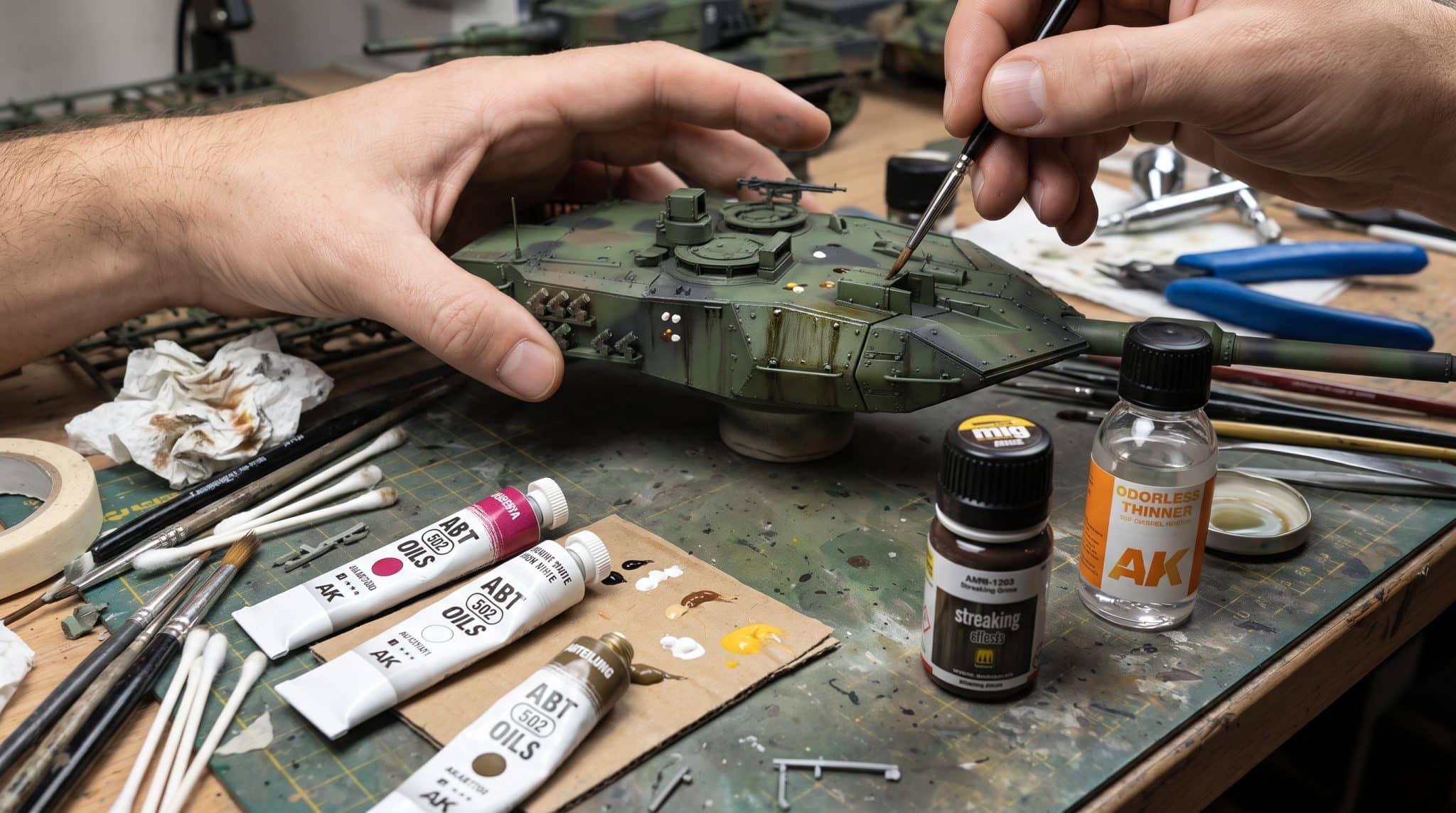
Oil Paint Rendering vs. Enamel Streaking Washes: How to Weather 1/35 Armor & Gunpla Without Making a Muddy Mess (2026 Bench Guide)
If you look inside the drawer of almost any armor or sci-fi modeler, you will find two competing philosophies staring back at you: a row of thirty pre-mixed enamel weathering bottles (labelled things like “Kursk Summer Dust” or “Engine Grime”), and five battered tubes of artist oil paint that have been sitting there since 2014 and somehow still haven’t dried out.
When comparing oil paint rendering vs enamel washes, both run on the exact same mineral spirits chemistry, and both will happily ruin an unsealed enamel basecoat if you aren’t paying attention. Yet they behave completely differently under a brush. Whether you are streaking rain marks down the turret cheeks of a tank from our Tamiya 1/48 F-14B Tomcat (#61129) & Border 1/35 Leopard 2A8 coverage, fading olive drab panels on a WWII fighter from the Kotare 1/32 Hurricane Mk.I, Eduard P-51B & ICM MiG-25PD Guide, or shading a Bandai Armored Core mech, knowing when to reach for a tube of oil and when to grab a pre-thinned enamel jar saves a lot of money—and prevents your kit from turning into a shinybrown brick.
Disclosure: Hobbyzero is reader-supported. If you pick up supplies through our links, we may earn a small coffee-fund commission at no extra cost to you.
⚡ The Real-World Bench Summary (No Marketing Fluff)
- The Cardboard Trick Is Mandatory for Tube Oils: Never put artist oil paint straight from the tube onto a model! Squeeze a pea-sized dab onto a scrap piece of corrugated cardboard for 30 minutes first. The cardboard sucks out the shiny linseed oil binder so the paint dries dead-flat instead of sticky and glossy.
- Enamels for Speed & Capillary Flow; Oils for Blending: Pre-mixed enamel bottles (AK, Ammo, Tamiya) dry in 20–40 minutes and flow into rivets faster. Artist oils stay workable for 12+ hours, making them unbeatable for feathering highlights, dot filters, and smooth grime gradients.
- Satin Varnish Beats Gloss for Dot Filtering: While pin-washing panel lines needs a smooth gloss coat, oil dot filtering and fading actually need a Satin or Semi-Matte acrylic/lacquer barrier so the microscopic surface tooth grabs the oil pigment.
- Use Odorless Turpenoid / White Spirit Only: Hardware store paint thinner will melt your acrylic basecoat and eat styrene plastic. Stick strictly to mild artist Odorless Mineral Spirits (OMS) or hobby-grade enamel thinner.
Tube Oils vs. Dedicated Modeling Oils vs. Enamel Jars
| Weathering Medium | Working Time | Dry Finish | What It Actually Does Best on the Bench | Link |
|---|---|---|---|---|
| Abteilung 502 Modeling Oils | 2 – 6 Hours | Matte / Satin | Low linseed-oil formula; dries faster and flatter than art-store tubes | Amazon |
| Winsor & Newton Artist Oils | 8 – 24 Hours | Matte (If Leached) | Superfine pigment grind; zero grittiness when blending dot filters | Amazon |
| AK / Ammo Enamel Streaking Grime | 15 – 30 Mins | Dead Flat / Satin | Pre-thinned vertical rain streaks, rust runs & fuel stains out of the jar | Amazon |
| Mr. Hobby Mr. Weathering Color | 20 – 45 Mins | Ultra-Matte | Oil-resin hybrid built for gunk-washing Gunpla, Star Wars & 1/35 tracks | Amazon |
| Mona Lisa / AK Odorless Thinner | Fast Evaporation | Zero Residue | Mild odorless mineral spirits; blends oils without lifting acrylic paint | Amazon |
Clearing Up the Biggest Myths About Oil & Enamel Weathering
A lot of beginners try oil paint weathering once, end up with a sticky tank that still has wet thumbprints on it four days later, and swear off oils forever. Here is why that happens—and how to fix it in five minutes:
1. The Cardboard Leaching Trick (Why Your Oils Stay Shiny and Wet)
Fine-art oil tubes (like Winsor & Newton or Rembrandt) are mixed with extra linseed or safflower oil so portrait painters can blend wet canvas paintings over several weeks. On a non-absorbent plastic model kit, that excess linseed oil has nowhere to go—so it sits on top of your turret looking like glossy bacon grease.
-
The Fix: Before you start weathering, squeeze small dabs of your oil colors onto a scrap piece of brown corrugated Amazon box cardboard and wait 20 to 30 minutes. You will see a big greasy ring soak into the cardboard around each dab. What’s left behind is pure, concentrated matte pigment paste that dries to the touch in a few hours and leaves a dead-flat finish!
2. Why Cheap “Student Grade” Art Store Oils Look Grainy
Don’t buy the $4 twelve-pack of no-name oil paints from the craft store aisle. Cheap student oils use coarse, poorly ground pigments mixed with fillers. When you thin them down with mineral spirits for a wash or filter, the pigment separates into ugly, gritty coffee grounds on the surface of your model. Stick to either artist-grade Winsor & Newton tubes or dedicated hobby oils like Abteilung 502 (which come pre-formulated with less linseed oil right out of the tube).
3. When Are Pre-Mixed Enamel Jars Actually Worth It?
Can you mix your own “Streaking Grime” or “Track Wash” from raw oil tubes? Sure. So why do experienced builders still keep jars of AK Interactive or Ammo by Mig enamels on their bench?
-
Drying Speed & Consistency: Enamel jars use a synthetic alkyd resin binder instead of slow-drying linseed oil. When you draw a vertical streak of AK Streaking Grime down a tank hull, it sets up into a workable tacky state in 10 minutes, letting you feather the edges with a damp brush and move on to the next step the same evening.
-
Capillary Pin-Washing: Thinned tube oils have slightly higher drag than enamel washes. For pure capillary action along narrow aircraft panel lines, pre-thinned enamels (as we covered in our How to Panel Line Without Cracking Plastic Guide) still run faster down the trench.
The 4 Weathering Staples Worth Keeping on Your Bench (Honest Pros & Cons)
1. Abteilung 502 Oil Paints (Starship Filth, Buff, Burnt Umber & Engine Grease) — Best Dedicated Hobby Oils
If you don’t want to guess which art-store shade matches German Dunkelgelb dust or sci-fi thruster soot, Abteilung 502 tubes are mixed specifically for scale modelers with a reduced-oil ratio. One single tube of ABT510 Starship Filth (a perfect neutral dark grey-brown) is arguably the most versatile weathering color in the hobby—working equally well on 1/35 tanks, Starfighters, and Gunpla inner frames.
✅ Why We Use It:
- Less linseed oil than canvas art paints means faster drying and a natural matte/satin finish
- One tube literally lasts 5 to 10 years on the workbench
- Blends effortlessly over acrylic basecoats sprayed using our Airbrush Thinning Chart
⚠️ Watch Out For:
- Still benefits from 15 minutes on a piece of cardboard before doing dead-flat dust effects
- Wipe the metal tube threads clean before screwing the cap back on, or you’ll need pliers to open it next month!
👉 Check price on Abteilung 502 Weathering Oil Sets on Amazon
2. Winsor & Newton Artists’ Oil Colour (Burnt Sienna, Yellow Ochre, Raw Umber, Titanium White) — Best for Dot Filtering
When Mike Rinaldi popularized **Oil Paint Rendering (OPR)**, the core idea was simple: use micro-dots of pure artist oil colors to shift the tone of individual armor plates, hatches, and weld seams right on the model. **Winsor & Newton Artists’ Grade** (or **Winton** series if on a budget) has such a fine pigment grind that you can feather it down to an invisible, translucent stain over 3-tone NATO camo—like on our Leopard 2A8 vs Leopard 2A7V builds—with zero tide marks.
✅ Why We Use It:
- Microscopic pigment density never looks grainy or chalky when thinned into a glaze
- 100% forgiving—if you hate how a streak looks two hours later, wipe it off with a clean damp brush and start over
⚠️ Watch Out For:
- Must be leached on cardboard first to remove the glossy safflower/linseed oil
- Avoid “Water-Mixable” Artisan oil tubes—stick to traditional mineral-spirit oil paints for smooth blending
3. AK Interactive / Ammo by Mig Streaking Grime & Rust Streaks — Best for Fast Vertical Rain Marks
When you just want to knock out twenty vertical rain streaks down the side skirts of a Sherman or add hydraulic fluid leaks under the wing hinges of a Tomcat after sealing your markings with our Micro Set vs Micro Sol Decal Guide, pre-mixed enamel jars save a ton of setup time. Shake the jar, paint a vertical line with a fine 00 brush, wait 10 minutes, and swipe downward with a flat brush barely dampened in odorless thinner.
✅ Why We Use It:
- Sets up in 15–30 minutes so you can seal or layer over it the same evening
- Can also be flicked off the bristles of an old toothbrush with a toothpick for micro-mud splatters
⚠️ Watch Out For:
- Pigment settles into a hard sludge at the bottom—stir with a metal rod before shaking!
- Just like panel liners, never flood raw enamel liquid into unglued snap-fit Gunpla joints
👉 Check price on AK Interactive Streaking Grime Sets on Amazon
4. Mona Lisa Odorless Paint Thinner / AK Odorless Turpentine — The Secret to Not Melting Your Basecoat
The #1 mistake modelers make with oils is grabbing a tin of hardware-store “Paint Thinner” or “Turpentine” from the garage. Hardware thinners are formulated to strip house paint off fences—they will eat right through your acrylic varnish and craze bare plastic. Always use artist-grade Odorless Mineral Spirits (OMS) like Mona Lisa, Gamsol, or AK Odorless Thinner, which are refined to remove aromatic hydrocarbons.
✅ Why We Use It:
- Zero harsh smell—ideal for indoor benches alongside our Apartment Compressor & Spray Booth Setups
- Gentle enough to scrub oil dots over cured Vallejo, AK 3G, or Tamiya acrylics without stripping the paint
⚠️ Watch Out For:
- “Odorless” doesn’t mean non-existent vapors—still crack a window or run your booth fan on low
The “95% Dry Brush” Rule for Blending Oils
If you apply dots of Yellow Ochre, Buff, Burnt Umber, and White to a tank hull and then hit them with a brush dripping with thinner, all you will get is a muddy tide ring around the edges of the plate.
Here is the actual workbench technique:
-
Dip a #2 or #4 flat synthetic brush into your Odorless Thinner.
-
Touch the bristles to a folded paper towel and hold it there for two full seconds until 95% of the liquid is gone. The brush should feel cool to the back of your hand, not wet!
-
Using vertical downward strokes on sloped armor (or circular stippling motions on flat horizontal turret roofs), blend the oil dots until they almost disappear—leaving just a subtle shift in tonal warmth across the panel.
-
Wipe the brush on the paper towel after every 3 or 4 strokes so you are removing excess pigment rather than smearing mud everywhere.
Frequently Asked Questions (FAQ)
Should I apply oil dot filters over a Gloss, Satin, or Matte varnish?
Never do oil dot filtering over a mirror-smooth Gloss coat—the oil will just slide around on the glass surface and wipe off completely when you try to blend it. On the flip side, a dead-flat Matte coat acts like sandpaper and stains too aggressively. A Satin (Semi-Gloss) acrylic or lacquer clear coat is the sweet spot: it has just enough microscopic tooth to grab a thin veil of oil pigment while still letting you feather the edges cleanly.
Why shouldn’t I use White oil paint on Olive Drab or Dark Green armor?
Titanium White oil paint contains chalky titanium dioxide pigment. If you dot pure white onto a dark Olive Drab Sherman or Russian 4BO green T-34, it turns the green into a milky, pastel mint color. Instead, use Naples Yellow, Buff, or Yellow Ochre to highlight and fade green armor—it warms up the green like real sunlight without turning it chalky!
Can I paint acrylics or spray a flat varnish over oil paint the next day?
Give leached oil paint at least 24 to 48 hours to off-gas its mineral spirits before spraying a water-based acrylic matte varnish over the top (pre-mixed enamel streaking grime usually cures overnight in 12 hours). If you want to speed up oil drying between layers, hold a standard household hairdryer 10 inches away on warm air for two minutes to flash off the thinner.
