
Mr. Surfacer 1500 vs Vallejo Primer vs Tamiya: Stop Paint Peeling

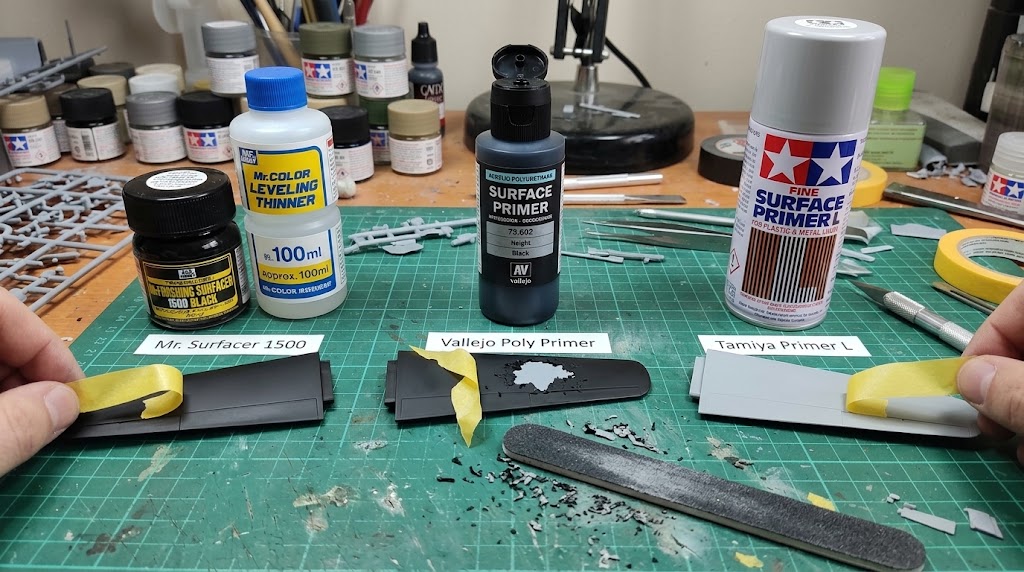
Mr. Finishing Surfacer 1500 Black vs. Vallejo Polyurethane Primer vs. Tamiya Fine Surface Primer: Why Your Masking Tape Peels Paint (2026 Bench Guide)
There is no silence in a hobby room quite as loud as the five seconds after you peel a strip of yellow masking tape off an aircraft wing—and watch three layers of camouflage, pre-shading, and primer come ripping right off with the tape, leaving a jagged patch of bare grey plastic staring back at you.
Or maybe you have experienced the other classic headache: you spot a tiny seam line after priming, touch it gently with a 600-grit sanding stick, and instead of feathering into smooth dust, the primer rolls up into rubbery little eraser boogers and tears off in a stretchy sheet. When you compare Mr. Finishing Surfacer 1500 vs Vallejo Primer and Tamiya Fine Surface Primer, you are actually comparing two completely different chemical worlds. Whether you are masking complex splinter camouflage on a jet from our Tamiya 1/48 F-14B Tomcat (#61129) & Border 1/35 Leopard 2A8 coverage or priming figures indoors with a setup from our Harder & Steenbeck Ultra 2024 vs Iwata Eclipse HP-CS vs GSI Creos PS-289 test, here is why primers peel—and which bottle belongs in your airbrush cup.
Disclosure: Hobbyzero is reader-supported. If you pick up supplies through our links, we may earn a small coffee-fund commission at no extra cost to you.
⚡ The Real-World Bench Summary (No Marketing Fluff)
- Why Vallejo / Polyurethane Primers Peel & Roll When Sanded: Water-based acrylic-polyurethane primers contain zero hot solvents—they cannot chemically melt into polystyrene. Instead, they form an elastic “shrink-wrap balloon skin” around the part. Sand through that skin or pull tape before a full 24–48 hour cure, and the whole sheet peels up like sunburned skin.
- Why Mr. Finishing Surfacer 1500 Never Peels: It is a solvent-based lacquer micro-filler. When thinned 1 : 1.5 with Mr. Color Leveling Thinner, the solvent physically bites into the top micron of bare styrene, fusing the primer into the plastic so you can wet-sand it to a mirror sheen 20 minutes later.
- 500 vs. 1000 vs. 1200 vs. 1500 Numbers Explained: Just like sandpaper grits, lower numbers (Mr. Surfacer 500) are thick liquid putties for filling cast armor texture, while Mr. Finishing Surfacer 1500 has ultra-fine pigment that preserves microscopic 1/48 aircraft rivets.
- The Mold-Release Grease Trap: Even the hottest lacquer primer will lift under tape if you don’t scrub fingerprints, sanding dust, and factory silicone mold-release oil off the bare plastic with dish soap or 70% IPA before priming!
Scale Model Primers Compared: Bite, Sandability & Fumes
| Primer Bottle / Can | Chemistry & Ratio | Sandability | Tape Bite | Real-World Job on the Bench | Link |
|---|---|---|---|---|---|
| Mr. Finishing Surfacer 1500 (Black / Grey / Pink) | Lacquer (1 : 1.5 with Leveling Thinner) | 10/10 (Feathers to dust) | 10/10 (Chemical weld) | The undisputed gold standard for aircraft, armor & heavy masking | Amazon |
| Tamiya Fine Surface Primer (L Spray Can / Jar) | Synthetic Lacquer Aerosol / Liquid | 9.5/10 (Wet-sands smooth) | 9.5/10 (Rock hard) | Fastest rattlecan primer for 1/24 car bodies & quick armor builds | Amazon |
| Badger Stynylrez / Ammo One Shot Primer | Water-Based Acrylic Polyurethane (Neat @ 25 PSI) | 7/10 (Wait 24h to sand) | 8/10 (Hardest water primer) | Best non-toxic indoor primer for 1/35 armor & wargaming miniatures | Amazon |
| Vallejo Polyurethane Surface Primer | Water-Based Polyurethane (5:1 Flow Improver) | 3/10 (Rolls & peels if sanded) | 6/10 (Needs 48h cure) | Zero-odor apartment priming for figures, tanks & unmasked builds | Amazon |
| Mr. Hobby Mr. Metal Primer-R | Clear Acid-Etch Bonding Resin | N/A (Clear coat) | 10/10 on Brass | Brush or spray onto shiny photo-etch brass & metal barrels before priming | Amazon |
Chemical Bite vs. Shrink-Wrap Skin: Why Vallejo Peels Under Tape
If you have ever wondered why half the internet swears by Vallejo Polyurethane Surface Primer while the other half swears it ruined their model, the answer comes down to what you build:
1. Why Miniature & Armor Painters Like Polyurethane Primers (And Aircraft Builders Hate Them)
If you are painting Warhammer miniatures or an unmasked 1/35 tank like our Tamiya 1/35 M36 (#35390) vs Full-Interior Armor Kits, you rarely need to sand the primer or slap heavy masking tape across the hull. You spray Vallejo Surface Primer (or Badger Stynylrez / Ammo One Shot) indoors with zero smell, let the polyurethane resin shrink-wrap tightly around the details overnight, and start painting with our ATOM by Ammo or Vallejo, Citadel & Tamiya Airbrush Ratios.
-
Where It Goes Wrong on Aircraft & Cars: Aircraft and automotive modelers constantly sand out seam lines after priming (check-priming) and apply layers of masking tape for canopy frames, walkways, and hard-edge camouflage. Because water-based polyurethane primer sits on top of slick plastic like a latex glove rather than melting into it, the moment your sandpaper breaks through one spot of that glove, the friction rolls the edge back like dead skin. Worse, if you stick Tamiya tape over Vallejo primer only two hours after spraying, the water underneath hasn’t fully cross-linked—so the tape rips the whole rubbery sheet off the wing!
2. Why Mr. Finishing Surfacer 1500 + Leveling Thinner Is “Liquid Magic”
GSI Creos Mr. Finishing Surfacer 1500 isn’t really just paint—it is ultra-fine micro-putty suspended in lacquer resin.
-
When you mix 1 part Mr. Surfacer 1500 with 1.5 parts Mr. Color Leveling Thinner (MLT) and spray it at 15–18 PSI, two things happen simultaneously: the lacquer solvent lightly etches into the bare polystyrene for a permanent chemical weld, while the retarder in Leveling Thinner pulls the surface tight like a drum skin.
-
Twenty minutes later, you can wet-sand it with a 2,000-grit sponge—and instead of rolling into rubbery balls, it sands into a silky powder with an invisible feather edge!
The 4 Primers Worth Keeping on Your Shelf (Honest Pros & Cons)
1. GSI Creos Mr. Finishing Surfacer 1500 (Black, Grey & Pink 40ml Jars) — The Undisputed King of Primers
Ask twenty competition winners at Scale ModelWorld or IPMS Nationals what they prime their kits with, and nineteen of them will hold up a 40ml glass jar of Mr. Finishing Surfacer 1500 Black (plus a bottle of yellow-label Mr. Color Leveling Thinner). Used for “Black Basing” aircraft and armor, it lays down a satin-smooth, ultra-thin coat that fills 1,000-grit sanding scratches while keeping the tiniest 1/72 and 1/48 rivets crisp.
✅ Why We Use It:
- Chemically bonds to styrene and cured Sprue Goo seams—virtually impossible to peel with masking tape
- Sands and polishes to a glass shine in 20 minutes with zero rubbery rolling
- Available in 1500 Black (for black-basing), 1500 Grey (for checking seams), and 1500 Pink (for undercoating yellow and red paint schemes)
⚠️ Watch Out For:
- Strong lacquer fumes—you must wear a 3M organic vapor respirator mask and vent your spray booth out a window!
- If you thin it with fast standard lacquer thinner in a humid room, it can spray “fuzzy” cobwebs—always thin 1 : 1.5 with Mr. Color Leveling Thinner!
👉 Check price on Mr. Finishing Surfacer 1500 + Leveling Thinner on Amazon
2. Badger Stynylrez / Ammo One Shot Primer — The Toughest Water-Based Primer for Indoor Benches
Can’t spray smelly lacquers in your apartment? Skip standard Vallejo primer and grab Badger Stynylrez (which is also bottled under license in Europe as Ammo by Mig “One Shot” Primer and Ultimate Primer). Unlike rubbery first-generation water primers, Stynylrez cures to a noticeably harder, drier matte shell that actually tolerates light 1,000-grit sanding and masking tape once cured overnight.
✅ Why We Use It:
- Sprays straight from the bottle with zero thinning through a 0.4mm–0.5mm nozzle at 25–28 PSI
- Shrinks tight over miniature details and 3D-printed parts from our Best Resin 3D Printers Guide with zero toxic odor
- Much better grip and scratch resistance than standard Vallejo polyurethane primer
⚠️ Watch Out For:
- Never let Stynylrez freeze in a cold mailbox during winter shipping—freezing ruins the polymer emulsion permanently!
- Rinse your airbrush cup immediately with water/cleaner before it dries inside the nozzle
👉 Check price on Badger Stynylrez / Ammo One Shot Primer on Amazon
3. Tamiya Fine Surface Primer L (Light Grey / White / Oxide Red Spray Can) — Zero-Airbrush Convenience
Sometimes you just want to walk out onto the balcony or garage, prime an entire 1/35 tank hull or 1/24 car body in ninety seconds flat, and walk back inside without cleaning an airbrush. Tamiya’s Fine Surface Primer (180ml L Can) has the finest atomizing nozzle of any spray can on Earth—it goes on half as thin as automotive hardware store primers and bites into bare plastic with legendary tenacity.
✅ Why We Use It:
- Zero airbrush cleanup—shake the can for 60 seconds, mist two light passes from 8 inches away, and you’re done
- Sands like a dream and creates an indestructible base for our Lacquer ➔ Acrylic ➔ Enamel Stacking Rule
⚠️ Watch Out For:
- Warm the spray can in a mug of lukewarm (not boiling!) tap water for 3 minutes before spraying so the propellant pressure atomizes ultra-fine!
👉 Check price on Tamiya Fine Surface Primer L (180ml Can) on Amazon
4. Mr. Hobby Mr. Metal Primer-R — How to Stop Paint Flaking Off Photo-Etch Brass
Even **Mr. Surfacer 1500** can chip off smooth, shiny photo-etch brass fenders or turned aluminum tank barrels if you bump them with a weathering brush. Before spraying your normal primer, brush a thin coat of clear Mr. Metal Primer-R directly onto the bare brass photo-etch parts (after lightly scuffing the brass fret with a 1,000-grit sponge). It acts like double-sided chemical Velcro between the metal and your primer!
4 Bench Habits That Stop Masking Tape from Lifting Paint Forever
Even with the best primer on the market, masking tape can still pull up a paint job if you skip basic surface prep. Follow these four habits on every build:
-
Wipe the Model with 70% IPA Before Priming: Every time you pick up a model wing while sanding seams or clipping parts with your GodHand or DSPIAE nippers, your fingers transfer natural skin oil onto the plastic. Combine that with factory mold-release agent (especially on older eastern European or resin kits) and fine sanding dust, and your primer is literally floating on grease! Wipe the assembled model down with a lint-free cloth dampened in 70% Isopropyl Alcohol (or warm dish-soap water) and handle it by a wooden paint stick from that point on.
-
De-Tack Your Masking Tape on the Back of Your Hand (Or Forehead!): Fresh Tamiya yellow kabuki tape is much gentler than hardware store blue painter’s tape (never put hardware tape on a scale model!), but even fresh Tamiya tape has too much bite for water-based acrylics. Before sticking a piece of tape onto your model, stick it to the back of your hand or your jeans once and peel it off. It picks up just enough microscopic lint to cut the adhesive strength by 30% while still sealing a razor-sharp paint edge!
-
Peel Tape Back at a 180-Degree Angle (Not Straight Up at 90 Degrees!): Never yank masking tape straight upward like a Band-Aid—that pulls vertically against your paint layer. Instead, fold the tape flat back over itself at a low 180-degree angle and pull slowly across the panel line.
-
If You Use Vallejo Primer, Wait a Full 24 Hours Before Masking: Water-based polyurethane primers feel dry to the touch in 15 minutes, so builders immediately spray their basecoat and slap masking tape on top an hour later. In reality, polyurethane resin takes 24 to 48 hours to cross-link and harden underneath. Give it a full night to cure, and you’ll cut peeling by 90%!
Frequently Asked Questions (FAQ)
What is the difference between Mr. Surfacer 500, 1000, 1200, and 1500?
Think of the numbers just like sandpaper grits:
-
Mr. Surfacer 500: Very thick liquid filler putty. Best stippled on with an old stiff paintbrush to create rough cast-iron armor texture on Sherman or T-34 turrets, or brushed into small sink marks and sanded flat.
-
Mr. Surfacer 1000 & 1200: Medium-fine primers that hide 400–600 grit sanding scratches on older kits or 3D-printed layer lines.
-
Mr. Finishing Surfacer 1500: The ultra-fine standard for modern kits (like Tamiya, Eduard, and Kotare). It is so fine that it will never flood delicate recessed rivets or panel lines.
Why did my Mr. Surfacer 1500 spray out like dusty spiderwebs (“cotton candy”)?
If Mr. Surfacer 1500 shoots out of your airbrush looking like fuzzy grey cotton candy or sandpaper dust in the corners of wing roots, your paint is drying in mid-air before it hits the model! This happens when you thin it less than 1:1, spray at too high a pressure (over 22 PSI), or use fast standard lacquer thinner. The Fix: Thin it 1 part Mr. Surfacer 1500 to 1.5 parts Mr. Color Leveling Thinner (MLT) and drop your airbrush pressure down to 15–18 PSI.
How do I clean Mr. Surfacer 1500 vs. Vallejo Polyurethane Primer out of my airbrush?
-
For Mr. Surfacer 1500 (Lacquer): Flush the cup with cheap hardware-store lacquer thinner, acetone, or our Tamiya Airbrush Cleaner #87089 trick—it dissolves 100% instantly in five seconds with zero scrubbing.
-
For Vallejo / Stynylrez Polyurethane Primer: Do NOT rinse with alcohol first (alcohol turns uncured polyurethane primer into gummy rubber shreds!). Flush the cup immediately with plain water and Vallejo Airbrush Cleaner while it is still wet, then finish with a final swipe of lacquer cleaner if any dried film clings to the needle.
