
Featuring The Latest Double Excellent Models VF-31 “Tomcatters” Decal Release

Felix’s Final Salute: Recreating the Legend with the Definitive 1/48 VF-31 “Tomcatters” Release
Discover the ultimate guide to modeling the F-14 Tomcat in 1/48 scale. Featuring the latest Double Excellent Models (DXM) VF-31 “Tomcatters” decal release, a technical deep dive into Tamiya’s masterwork F-14A, and the essential F-14B conversion kits. Explore the storied history of the U.S. Navy’s last Tomcat squadron and their iconic mascot, Felix the Cat.
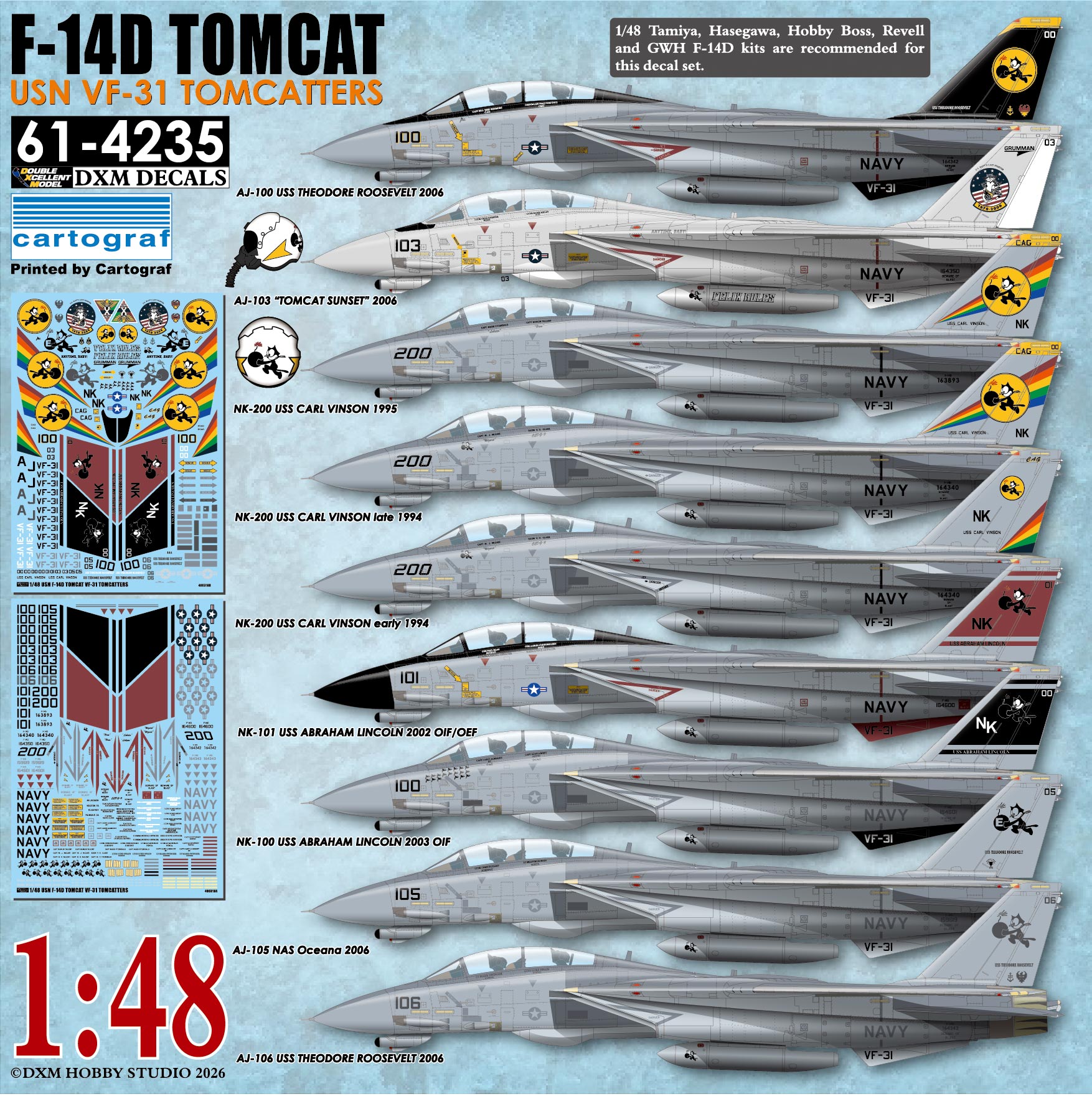
DXM Decals VF-31 Tomcatters: Key Profile & Application Specs
Quick Verdict: DXM Decals (Double Excellent Models) delivers a premium Cartograf-printed decal sheet commemorating the U.S. Navy’s storied VF-31 / VFA-31 “Tomcatters”. Featuring razor-sharp resolution for the iconic Felix the Cat insignia, vibrant high-visibility CAG schemes, and ultra-thin carrier film, this set delivers flawless conformability over complex panel lines without silvering.
| Specification | DXM Decal Product Details |
|---|---|
| Manufacturer & Origin | DXM Decals (Double Excellent Models) — Taiwan |
| Subject Squadron | VF-31 / VFA-31 “Tomcatters” (Historic Felix the Cat emblem, tracing back to VF-6) |
| Aircraft Types Covered | Grumman F-14 Tomcat (F-14A / F-14D) and Boeing F/A-18E Super Hornet |
| Scales Available | 1/48 and 1/72 Scale (Individual dedicated sheets) |
| Printing Company | Cartograf (Italy) — Silkscreen printing with zero color bleeding |
| Target Kit Tailoring | Tamiya 1/48 F-14A/D, Hasegawa 1/48 & 1/72, AMK, Meng Model |
| Chemical Compatibility | Microscale Micro Set / Micro Sol, Mr. Mark Setter / Softer, Walther’s Solvaset |
Key Modeler Advantages of DXM Tomcatters Decals
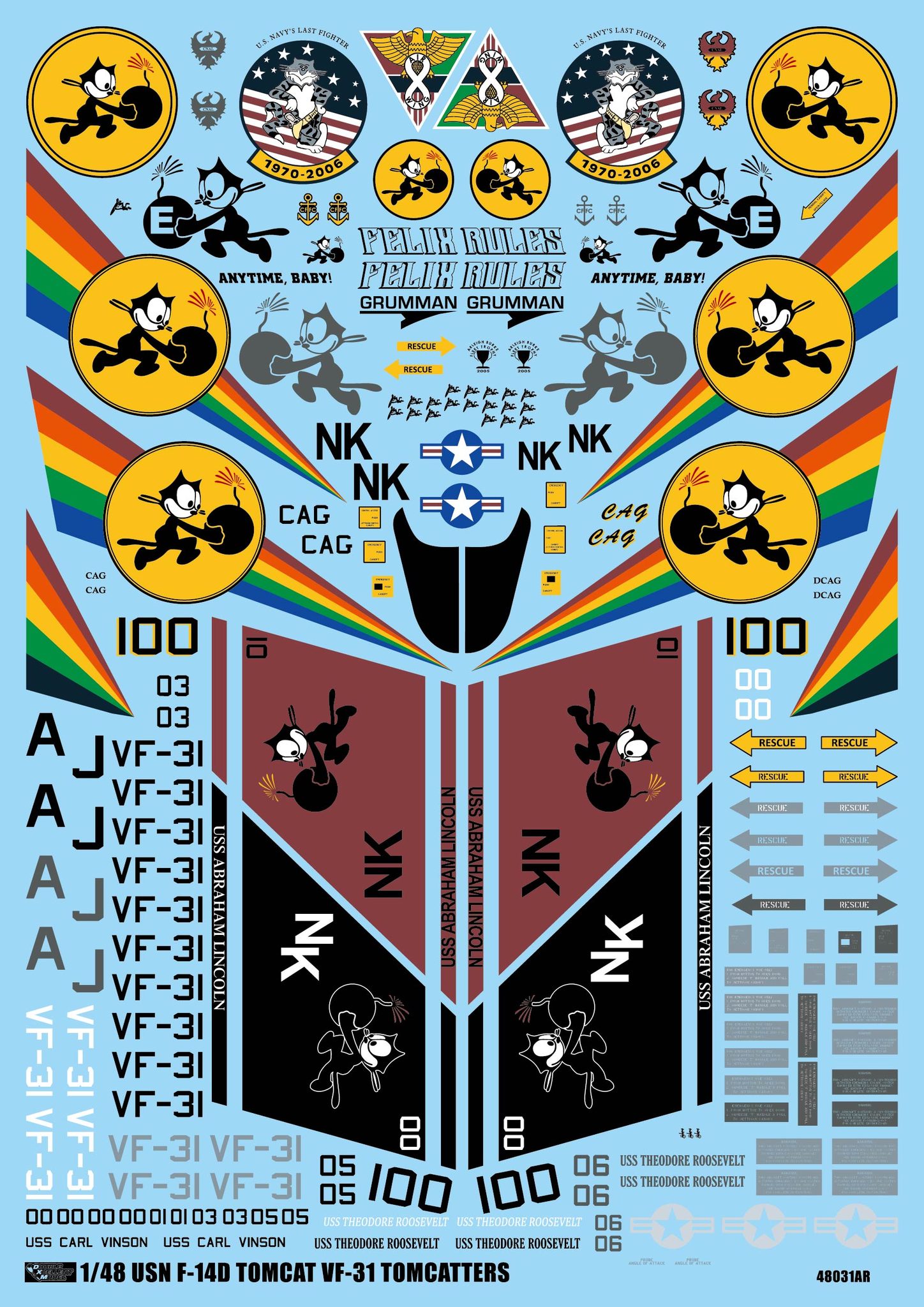
- Cartograf Silk-Screen Precision: Printed in Italy by Cartograf, ensuring solid white opacity on the Felix chest and bomb emblem without base paint color showing through.
- Ultra-Tight Carrier Film Borders: Decal clear carrier film extends less than 0.2mm from printed graphic edges, drastically lowering the risk of edge ridges and silvering over curved tail fins.
- Full Maintenance Stencil Suite: Includes comprehensive walkway lines, formation “slime” lights, ejection seat warnings, and intake chevrons with legible micro-type.
- Tail Fin Contour Fit: Designed with exact curve clearances for Tamiya and Hasegawa vertical tails, eliminating the need to slice or stretch large squadron tail artwork.
Frequently Asked Questions: VF-31 Tomcat Decals
What is the best setting solution for DXM Cartograf decals?
Cartograf film reacts best to a two-step system: use Microscale Micro Set (blue bottle) on the plastic to float and position the decal, then apply Microscale Micro Sol (red bottle) or Mr. Mark Softer over the surface to melt the film tightly into recessed panel lines and rivets.
Why is VF-31 associated with VF-6 in search listings?
VF-31 is the second-oldest continuously active US Navy squadron. It traces its official lineage and the famous *Felix the Cat* emblem back to the pre-WWII Fighting Squadron Six (VF-6 / VF-3), making both terms common in historical naval aviation searches.
How do I avoid silvering on large Tomcat tail markings?
Always apply decals over an ultra-gloss clear coat (such as LP-9, GX-100, or Gauzy Agent). Allow the setting solution to pull the decal completely flat into all surface crevices before sealing with your final semi-gloss or flat varnish.
For the scale modeling community, the Grumman F-14 Tomcat is more than just an aircraft; it is a cultural icon, a symbol of Cold War naval power, and a masterpiece of 20th-century engineering. From the high-visibility “Jolly Rogers” schemes of the 1970s to the grimy, battle-hardened “Bombcats” of the early 2000s, the F-14 has remained a staple on workbenches for decades. However, the news currently rippling through the community centers on a specific unit—the legendary VF-31 “Tomcatters”.
With the recent announcement on AeroScale regarding the release of the Double Excellent Models (DXM) 1/48 scale decal set for the F-14D Tomcatters, modelers now have the definitive tool to recreate the final decade of this storied squadron. Covering the pivotal years from 1994 to 2006, this release provides the high-fidelity markings necessary to pay tribute to the men and machines that conducted the “Tomcat Sunset.”
In this comprehensive guide, we will analyze the technical merits of this new decal set, explore the kits it was designed for—including the industry-standard Tamiya 1/48 F-14A and the essential F-14B conversion kits—and dive deep into the fascinating history of the squadron that flew the “Cat” into the history books.

Part I: The News – DXM’s Definitive VF-31 “Tomcatters” Decal Set
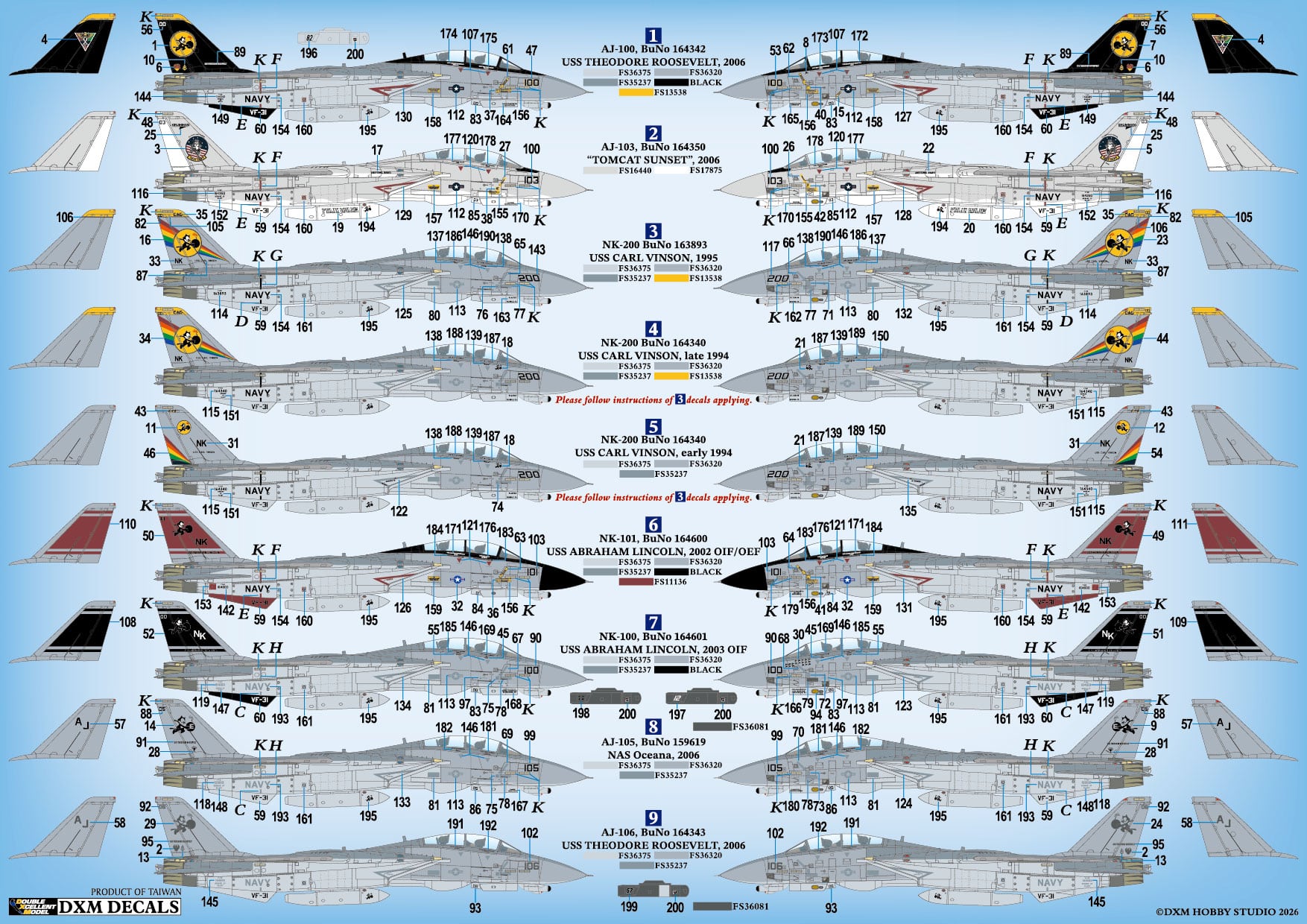
The recent release by Double Excellent Models (DXM), as highlighted by AeroScale, is a targeted and timely addition to the aftermarket landscape. While there have been many Tomcatters decals over the years, the DXM set is specifically engineered for the high-detail requirements of modern 1/48 scale kits, particularly those from Tamiya and AMK.
Technical Specifications and Coverage
This set focuses exclusively on the F-14D Super Tomcat, the ultimate “Digital Cat” that served as the backbone of the fleet’s precision strike capability in its twilight years. The decals cover a broad historical sweep from 1994 through to the retirement ceremonies in 2006.
Key features of the set include:
-
Carrier Assignments: Markings for aircraft stationed aboard the USS Carl Vinson (CVN-70), USS Abraham Lincoln (CVN-72), and the USS Theodore Roosevelt (CVN-71).
-
Subject Variety: The set includes CAG (Carrier Air Group) birds with their vibrant black-and-yellow accents, as well as the “low-viz” line jets that bore the brunt of combat operations in Iraq and Afghanistan.
-
Print Quality: Printed by Cartograf of Italy, these decals offer industry-leading registration and thinness, ensuring they conform perfectly to the complex curves of the Tomcat’s fuselage and “beaver tail.”
-
The “Sunset” Scheme: Most importantly, the set includes the specialized markings for the 2006 “Tomcat Sunset” aircraft, allowing modelers to recreate the final official flights of the F-14.
For the modeler, the challenge of the F-14D is often in the details—the NACES ejection seats, the PTIDS (Programmable Tactical Information Display System) in the RIO’s cockpit, and the unique chin pods. DXM’s decals complement these technical nuances with legible stenciling and accurate squadron insignia.

Part II: The Foundation – Tamiya’s 1/48 F-14A and the Conversion Path
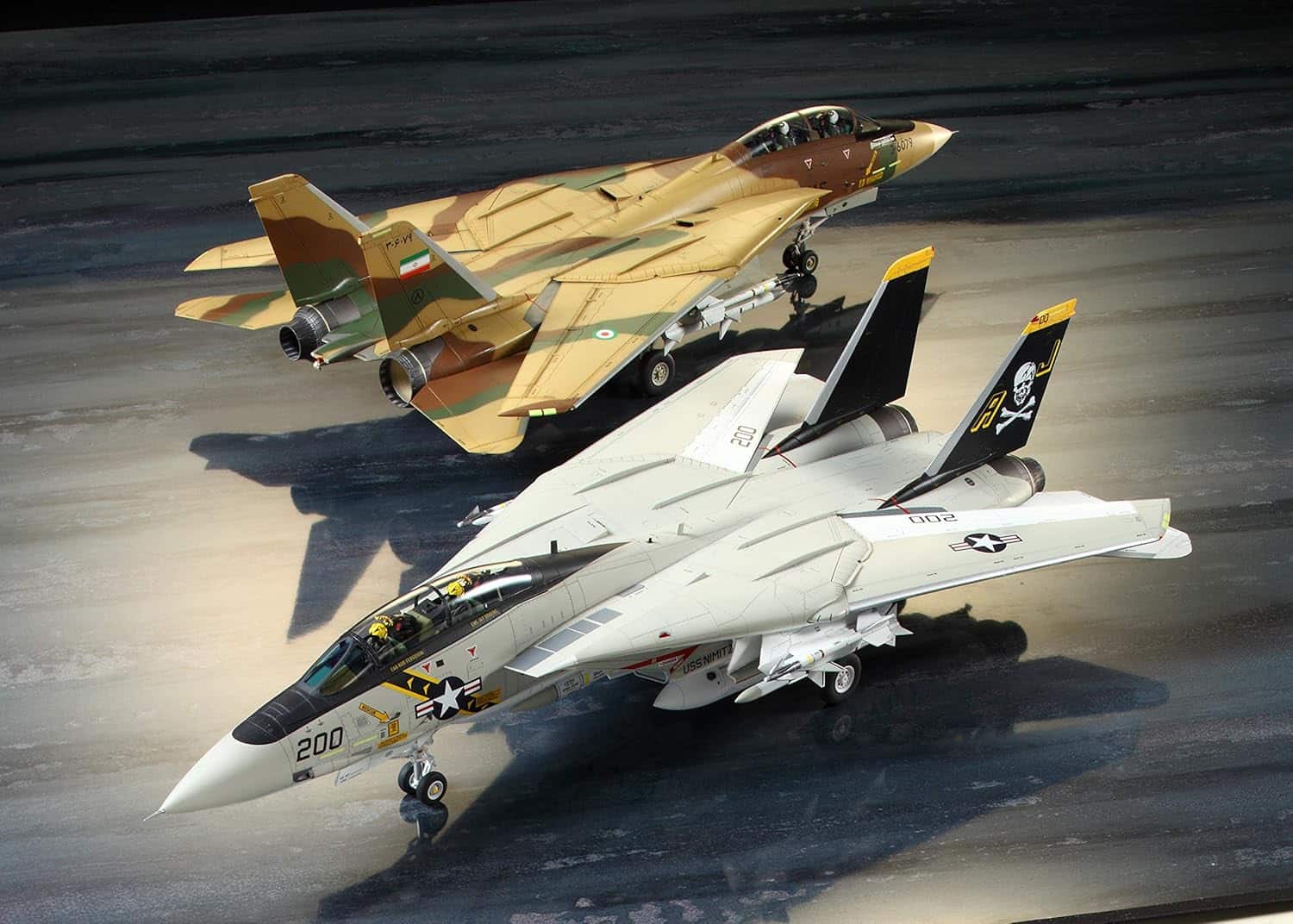
To use these high-end decals, a world-class kit is required. As detailed in the resources from HobbyZero, the current king of the 1/48 Tomcat hill is undoubtedly Tamiya.
The Tamiya 1/48 F-14A: A Masterclass in Engineering
Tamiya’s release of the Grumman F-14A Tomcat (Item 61114) revolutionized the market. For years, modelers struggled with the complex fit of older Tomcat kits (notably the Hasegawa tooling). Tamiya solved these issues with a “definitive” kit that prioritized fit and ease of assembly without sacrificing detail.
-
Variable Sweep Wings: The hallmark of the Tomcat is its variable-geometry wing. Tamiya’s kit features a robust internal mechanism that allows the wings to move between 20° and 68°. Cleverly, the kit includes interchangeable “air bags” and sealing plates so the wings can be posed at different angles without leaving unrealistic gaps.
-
Slide-Molding Technology: Tamiya utilized slide-molding for the canopy and intakes, ensuring a seamless look that mimics the actual aircraft’s structure.
-
Weaponry: The F-14A kit includes a full suite of weapons—AIM-54 Phoenix, AIM-7 Sparrow, and AIM-9 Sidewinder missiles—allowing for the classic fleet defense loadout.
The Path to the B and D Variants
While Tamiya’s base kit is an “A” model, many of the most interesting “Tomcatters” schemes—including those in the new DXM set—belong to the F-14B and F-14D variants. This is where conversion kits become essential.
As noted on HobbyZero, specialized F-14B/D conversion kits are available to adapt the Tamiya base. The primary differences modelers must address include:
-
The Engines: The F-14A used the Pratt & Whitney TF30, whereas the B and D used the much more powerful General Electric F110-GE-400. This requires new engine nozzles and shroud parts.
-
The Cockpit: The F-14D cockpit was a significant departure from the A and B models, featuring the aforementioned PTIDS and MFDs (Multi-Function Displays).
-
Chin Pods: Late-model Tomcats featured a variety of under-nose sensors, including the TCS (Television Camera Set) and IRST (Infrared Search and Track) pods, which must be accurately modeled to match specific Bureau Numbers (BuNos) provided in the decal sets.

Part III: The Legend of the “Tomcatters” – A Century of Aviation History
To model VF-31 is to model a piece of American military heritage. Established in 1935 as VF-1B, the “Tomcatters” are the second-oldest active U.S. Navy fighter squadron. Their history is decorated with combat milestones across three major wars.
The Mascot: Felix the Cat
The most recognizable feature of any VF-31 model is the mascot: Felix the Cat running with a spherical black bomb with a lit fuse. This logo, adopted in the 1920s, is one of the most iconic insignias in all of aviation.
The story of Felix is one of wily survival. The mascot was originally part of VB-2B, known as the “Felix Cat Squadron.” When that unit was reorganized, the pilots fought to keep their beloved cat. Through various redesignations—VF-6, VF-3, and finally VF-31 in 1948—Felix remained, a constant companion to legendary aviators like Butch O’Hare (the Navy’s first Ace of WWII and namesake of Chicago’s airport) and Charles Lindbergh, who flew as a civilian advisor with the unit.
The F-14 Era and Combat Success
VF-31 received the F-14A in 1981, beginning an association with the “Cat” that would last for 25 years. They were a frontline unit in every sense of the word.
-
Operation Iraqi Freedom (2003): VF-31 achieved the first air-to-air kill of the conflict when one of their Tomcats shot down an Iraqi Mi-8 helicopter using an AIM-9 Sidewinder.
-
The Bombcat Transition: In the 1990s, with the addition of the LANTIRN (Low-Altitude Navigation and Targeting Infrared for Night) pod, VF-31’s Tomcats evolved into precision strikers. During their final deployments, they dropped hundreds of thousands of pounds of precision ordnance (LGBs and JDAMs) in support of ground troops.
Part IV: Real Events – The Tomcat Sunset of 2006
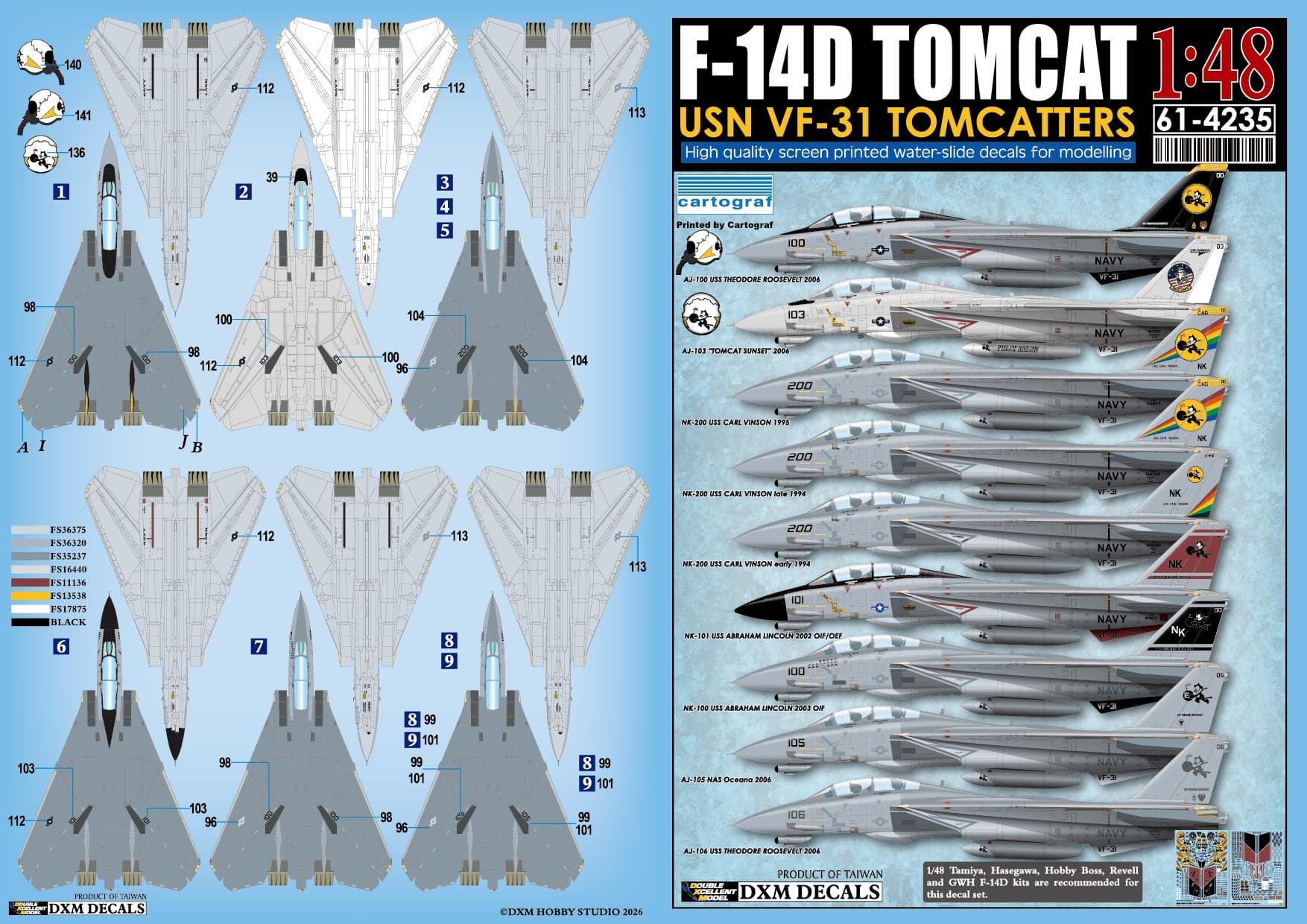
The true emotional weight of the new DXM decal release lies in the “Tomcat Sunset” aircraft. In September 2006, the U.S. Navy officially retired the F-14, and VF-31 was the last squadron to fly it operationally.
The Final Deployment
The squadron’s final cruise was aboard the USS Theodore Roosevelt (CVN-71) as part of Carrier Air Wing Eight (CVW-8). In early 2006, while operating in the Persian Gulf, VF-31 conducted the very last combat missions ever flown by a Tomcat. On February 7, 2006, the last F-14 recovery from a combat mission took place on the Roosevelt’s deck—a moment witnessed by journalists from around the globe.
Bureau Number 164603
For modelers, one particular aircraft stands above the rest: BuNo 164603. This was the specific F-14D that conducted the final official flight for the U.S. Navy on October 4, 2006. It flew from NAS Oceana to Republic Airport in New York, where it was eventually put on display. The DXM decal set includes the specific “Tomcat Sunset” markings for this historic airframe, allowing modelers to build a 1/48 scale replica of the very last “Cat” to roar through the skies.
Part V: Modeling the VF-31 F-14D – Tips for the Bench
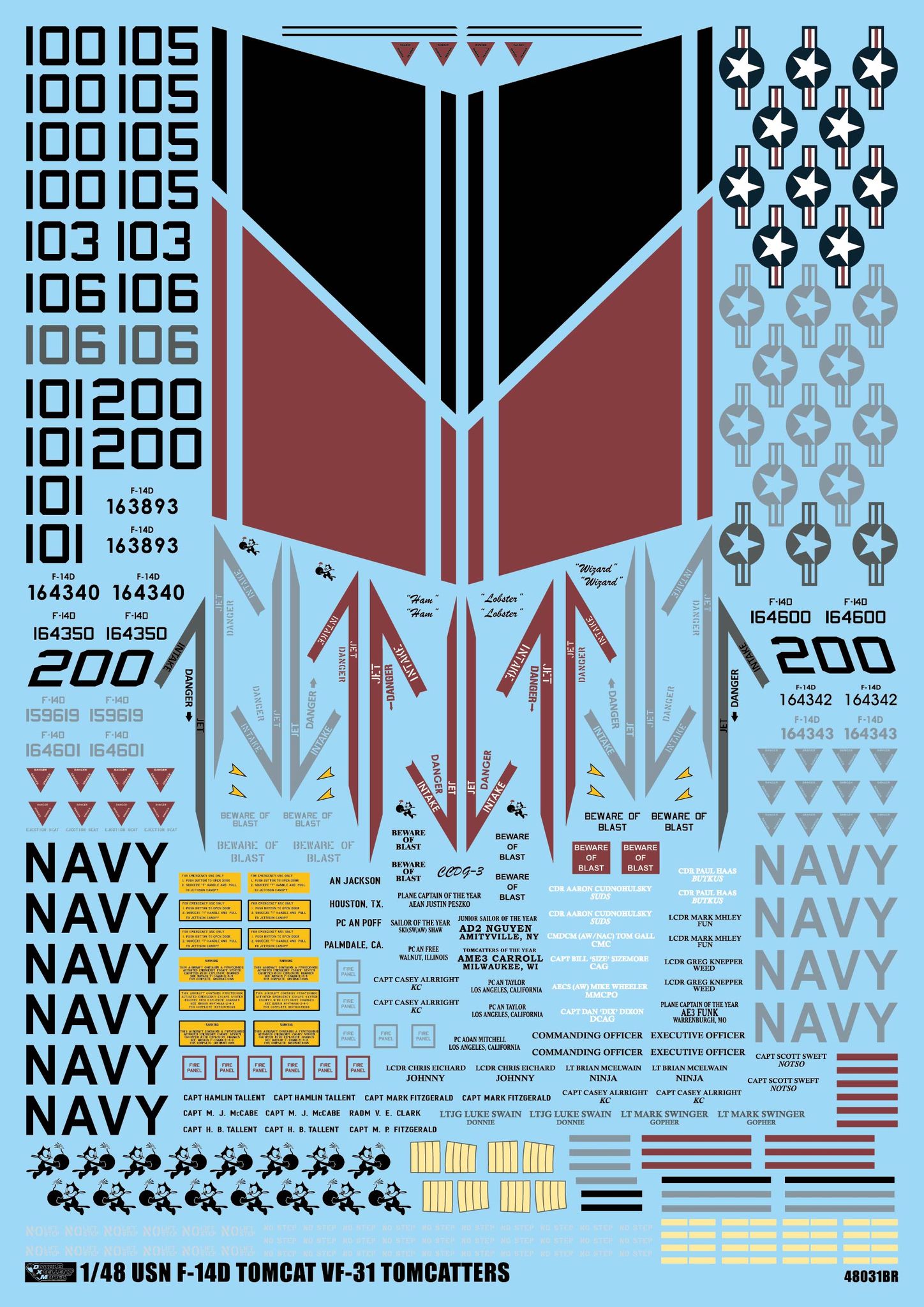
Building a “Tomcatters” jet requires a balance of clean engineering and heavy weathering. Late-war Tomcats were notoriously “dirty” aircraft due to the harsh salt-spray environment of carrier decks and the constant cycling of the variable-sweep wings.
-
Weathering the Wing Sweeps: The wings of an F-14 leave characteristic “scuff marks” on the top of the fuselage (the wing glove area) as they sweep back and forth. Using oils or pastels to replicate these grease-stained arcs is essential for realism.
-
TPS (Tactical Paint Scheme) Variation: Modern Navy jets use a three-tone grey scheme (FS35237, FS36320, and FS36375). These colors faded differently and were often “spot-primed” with fresh paint, creating a patchy, “monstrous” look. Refer to the reference photos in the Aeroscale and HobbyZero links to see how the VF-31 jets looked during their final days on the Roosevelt.
-
The Felix Decals: When applying the Felix decals to the tail, ensure you have a good gloss coat. Felix’s yellow background is striking, and even the slightest silvering will ruin the effect. Cartograf decals (like those in the DXM set) react exceptionally well to setting solutions like Micro Sol.
Conclusion: A Tribute in Plastic
The release of the DXM VF-31 “Tomcatters” decal set is more than just a new product; it is an invitation to revisit one of the most meaningful chapters in naval aviation history. By combining these definitive markings with the superlative engineering of Tamiya’s 1/48 F-14, modelers can create a tribute that captures both the technical complexity of the Super Tomcat and the spirit of the pilots who flew under the banner of the bomb-toting cat.
The F-14 may no longer fly off the decks of carriers, but through the hands of skilled model makers and the support of high-quality news and technical resources like AeroScale and HobbyZero, the “Cat” remains alive. Whether you are building the vibrant AJ-100 CAG bird or the historic BuNo 164603 for the Sunset, you are preserving a legacy of speed, power, and courage.

Bonjour Monsieur,
fan absolu du F-14 depuis qu’il existe, hé oui 80 balais le mois prochain, je me suis dit il serait plus que temps de me payer une maquette avant de faire le grand saut. Et, par hasard, je ne sais plus comment, je suis arrivé sur le site d’Hobbyzero.com où je viens de lire votre article sur le F-14. Super article qui m’a rappelé qu’une machine de guerre évolue avec les années et donc, vu le nombre de versions existantes il est bien évident que je ne ferai qu’une seule maquette. Ma question : quelle version pourriez-vous me conseiller, la dernière? De quelle marque ? apparemment Tamiya. Peut-être acheter une maquette déjà contruite.
D’avance merci pour vos conseils. Bonne journée.
Bien à vous.
Hello,
First of all, thank you very much for your kind and heartfelt comment! 🎉 It truly made our day. Being a fan of the legendary F-14 Tomcat since its first appearance is something many of us can relate to, and deciding to start a scale model at nearly 80 years old is absolutely inspiring — it’s never too late to enjoy a great hobby.
The F-14 is a timeless aircraft and a fantastic choice for a first build. For a smooth and enjoyable experience, we highly recommend Tamiya’s F-14 Tomcat kits. Tamiya is well known for its excellent engineering, precise fit, and clear instructions, which makes their kits suitable even if you are building your first model.
If you would like a high-quality option that delivers impressive results right out of the box, you may want to take a look at this recommended model:
👉 https://amzn.to/49AAASh
This kit offers a great balance between detail and buildability, and it looks stunning once completed. You can also enhance it later with decals or additional details if you wish.
Thank you again for sharing your story with us. We wish you many enjoyable and relaxing hours building your F-14 Tomcat. Please feel free to reach out if you have any further questions — we’ll be happy to help.
Kind regards,
HobbyZero Team