
Micro Set vs Micro Sol vs Mr. Mark Softer: Stop Decal Silvering

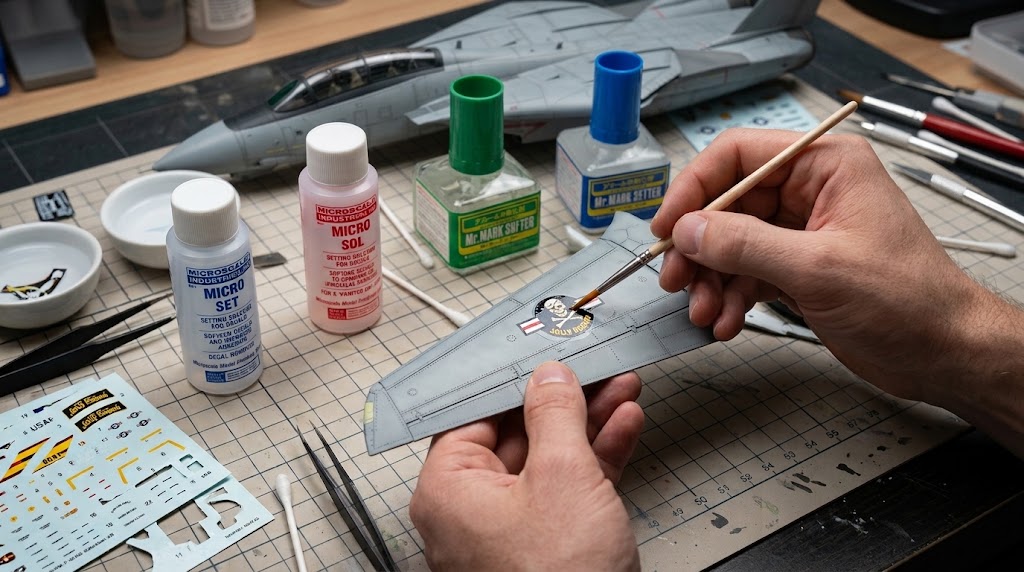
Micro Set vs. Micro Sol vs. Tamiya Mark Fit: What Actually Works on Stubborn Decals (2026 Bench Guide)
Let’s be honest: we have all had that moment where a build is going great, the camouflage looks spot-on, and then a squadron roundel dries overnight with a frosty silver halo screaming out from underneath the clear film. Or worse, the decal sits right across a recessed panel line like a stiff wooden plank, completely ignoring three coats of softener.
When you start comparing Micro Set vs Micro Sol, Mr. Mark Setter/Softer, and Tamiya Mark Fit Strong / Super Strong, a lot of old advice floating around the internet gets the chemistry wrong. Not all “European” decals are delicate flowers, and not all softeners are strong enough to touch modern kit transfers. Whether you are wrestling with thick box decals on the newly announced Tamiya 1/48 F-14B Tomcat (#61129) & Border 1/35 Leopard 2A8, laying down aftermarket sheets like the Double Excellent Models VF-31 “Tomcatters” Release, or dealing with Eduard’s stretchy peelable transfers, here is how these bottles actually behave on the workbench.
Disclosure: Hobbyzero is reader-supported. If you pick up supplies through our links, we may earn a small coffee-fund commission at no extra cost to you.
⚡ The Real-World Bench Summary (No Marketing Fluff)
- Setters Are Wetting Glue; Softeners Are Solvents: Micro Set (Blue) and Mr. Mark Setter go under the decal to help it stick and slide. Micro Sol (Red), Mr. Mark Softer, and Tamiya Mark Fit Strong/Super Strong melt the film so it conforms over rivets.
- The Cartograf Myth: Modelers don’t love Italian Cartograf decals because they are ultra-thin; we love them because they are sturdy, slightly above average in thickness, refuse to tear when you nudge them around, and still settle down beautifully under almost any softener.
- Mr. Mark Softer Isn’t Enough for Thick Tamiya Decals: Ever since GSI Creos reformulated green-cap Mr. Mark Softer to be milder, it struggles with thick out-of-the-box Tamiya decals. Skip straight to Tamiya Mark Fit Strong or Super Strong.
- Modern Eduard Decals Are Tank-Tough: Post-2020 Eduard decals are rubbery and notoriously stubborn. Even Tamiya Super Strong won’t damage them—in fact, it’s often the only thing that convinces them to settle down before you decide whether to peel the carrier film.
Real-World Decal Solutions Compared: Actual Solvent Bite
| Bottle on the Bench | What It Actually Is | Solvent Bite | Real-World Behavior & Best Match | Link |
|---|---|---|---|---|
| Microscale Micro Set (Blue) | Wetting Agent (Acetic Acid) | 1/5 (Very Mild) | Smells like vinegar; breaks water tension under the decal | Amazon |
| Mr. Hobby Mr. Mark Setter (Blue) | Liquid Decal Glue + Mild Softener | 2/5 (Mild + Adhesive) | Works on every decal brand; keeps low-tack transfers stuck down | Amazon |
| Microscale Micro Sol (Red) | Classic Film Softener | 2.5/5 (Gentle-Medium) | Great for thin Microscale, Techmod & older fragile Italeri sheets | Amazon |
| Mr. Hobby Mr. Mark Softer (Green) | Medium Softener (Reformulated) | 3/5 (Medium) | Fine for Bandai & Cartograf, but too mild for thick Tamiya slabs | Amazon |
| Tamiya Mark Fit Strong / Super Strong | Heavy-Duty Film Melter | 5/5 (High Bite) | Essential for thick Tamiya decals, stubborn Eduard & Airfix sheets | Amazon |
Clearing Up the Biggest Myths About Decal Chemistry
If you read five different modeling forums, you will hear five different theories about why decals wrinkle, silver, or refuse to budge. Let’s look at what actually happens on the plastic:
1. Why Mr. Mark Setter Should Be on Everyone’s Desk (Regardless of Kit Brand)
A lot of guides pigeonhole blue-cap Mr. Mark Setter as “just for Japanese kits.” In reality, Mark Setter is simply a practical, pre-mixed decal adhesive suspended in a wetting agent (which is why it looks slightly milky at the bottom of the jar). Even the best decals can lose their factory glue if you soak them a few seconds too long in water, or if you are sticking them onto a tight curve like a missile body. Brushing a little Mr. Mark Setter under any decal—whether it’s Cartograf, Airfix, Eduard, or Bandai—guarantees the edges won’t curl up dry the next morning.
2. Cartograf vs. Eduard vs. Thick Tamiya Decals: What Can Take the Heat?
-
Cartograf Decals: There is a common misconception that Cartograf decals are ultra-thin. They aren’t! Cartograf sheets are actually above average in thickness and toughness—which is why you can slide a huge fuselage stripe into position without it folding over onto itself and ruining your evening. Because their pigment and carrier resin are so well-engineered, they respond politely to everything from mild Micro Sol all the way up to Tamiya Mark Fit Strong.
-
Modern Eduard Decals: If you have built a post-2020 Eduard kit (or our featured November release, the Kotare 1/32 Hurricane Mk.I, Eduard P-51B & ICM MiG-25PD Wave), you know their current decals are thick, slightly stretchy, and famously stubborn. Mild softeners barely tickle them. You can hit modern Eduard decals with Tamiya Mark Fit Super Strong without any fear of melting them—in fact, some of them still need a firm roll with a damp cotton bud just to sink into deep panel lines!
-
Thick Out-of-Box Tamiya & Hasegawa Decals: Years ago, green-cap Mr. Mark Softer had a much hotter chemical bite. Today’s reformulated version is noticeably milder. If you try using modern Mr. Mark Softer or red Micro Sol on a thick in-box Tamiya decal, it will bridge right over the panel lines. Save yourself the headache and reach straight for Tamiya Mark Fit Strong (or Super Strong).
-
When Should You Actually Be Careful? The only times you need to baby a decal with mild Micro Sol are when dealing with paper-thin Polish Techmod sheets (which curl into a tube if you breathe on them), ultra-thin US Microscale/Furball sheets, or older vintage Italeri decals that can wrinkle permanently if hit with hot solvents.
The 5 Bottles Worth Keeping in Your Drawer (Honest Pros & Cons)
1. Tamiya Mark Fit (Strong & Super Strong) — The Real Heavy Hitter for Stubborn Decals
If you only buy one high-strength softener this year, make it Tamiya Mark Fit Strong (or Super Strong). Tamiya formulated this specifically because their own box decals are thick enough to survive nuclear winter. It also works wonders on modern Airfix, Eduard, and 1/24 carbon-fiber weave decals—like the supercar sets in our S.K. Decals 1/24 Release—pulling stiff transfers down into deep hinge lines where milder fluids fail.
✅ Why We Use It:
- Actually melts thick Tamiya, Hasegawa, Airfix, and stubborn Eduard decals into rivets
- Square bottle refuses to tip over on a messy bench and includes a brush in the cap
- Saves you from applying five separate coats of weaker solutions
⚠️ Watch Out For:
- Don’t let big puddles sit on bare, unvarnished water-based acrylics—spray a lacquer or cured gloss barrier first (see our Airbrush Thinning Chart)
- Test on a spare scrap number decal before using “Super Strong” on older 1990s Italeri kits
👉 Check price on Tamiya Mark Fit Strong / Super Strong on Amazon
2. GSI Creos Mr. Mark Setter (Blue Cap) — Best Universal Under-Decal Adhesive
Think of Mr. Mark Setter as insurance against silvering and peeling. Because it contains actual suspended adhesive resin along with a mild softening agent, brushing a thin swipe onto the model before sliding your decal off the paper ensures that even old stash decals or low-tack Bandai water-slides stay permanently bonded once dry.
✅ Why We Use It:
- Works universally under any decal brand—especially helpful on curved missile tubes and tank barrels
- Replaces washed-away factory glue if you accidentally leave a decal in the water dish too long
- Often enough on its own for flat surfaces without needing a second softener step
⚠️ Watch Out For:
- Wipe away any squeezed-out milky droplets around the decal edge with a damp cotton bud so the glue doesn’t dry as a Tide mark
3. Microscale Micro Set & Micro Sol — The Gentle Classic for Thin Aftermarket Sheets
While red Micro Sol won’t phased a thick Tamiya wing walk or a stubborn Eduard stencil, it remains the safest bet when you are working with genuinely thin aftermarket sheets (like Microscale, Techmod, TwoBobs, or custom-printed decals) or applying transfers over delicate water-based acrylic glazes from our Slapchop vs Zenithal Highlighting Guide.
✅ Why We Use It:
- Zero risk of eating through delicate acrylic paint jobs or crinkling ultra-thin aftermarket transfers
- Works nicely with Cartograf sheets (like those inside Babibi Models F-4E Stencils) when given two applications
⚠️ Watch Out For:
- Tall, skinny bottles have a center of gravity designed by someone who hates modelers—stick them in a foam holder or Blu-Tack them to the desk before you spill half a bottle!
👉 Check price on Microscale Micro Set & Micro Sol Twin Pack on Amazon
Bench Tricks When a Decal Still Refuses to Behave
Even with the right bottles on your desk, some decals put up a fight. Here are three old-school modeler tricks that actually work:
-
The “Hot Compress” Trick for Thick Japanese & Eduard Decals: If a thick Tamiya or Eduard decal is still bridging across a deep panel line after hitting it with Mark Fit Strong, dip a corner of a paper towel or cotton swab into steaming hot water (from a mug next to your bench), press it firmly onto the softened decal for 10 seconds, and roll. The heat makes the vinyl/resin carrier film thermo-form right into the trench!
-
Prick & Flood for Overnight Silvering: Spotted a silver air bubble the next morning? Take a fresh #11 scalpel blade, poke 4 or 5 tiny pinholes right inside the silvered spot (or slice cleanly down the panel line), and touch a drop of Tamiya Mark Fit Strong or Micro Sol onto the holes. It will wick underneath the decal and pull it flat. Once dry, seal it with a wet pass of lacquer clear gloss before your final flat coat, and you are ready for safe washes using our How to Panel Line Without Cracking Plastic Guide.
-
To Peel or Not to Peel Eduard Decals? On post-2020 Eduard kits, you can peel off the top clear carrier film 24 hours after applying them (using low-tack yellow kabuki tape or a swab barely dampened with odorless mineral spirits). Just remember: you don’t have to peel them if a good coat of Tamiya Super Strong and a leveled clear coat already hid the step edge!
Frequently Asked Questions (FAQ)
Which goes on first: Micro Set or Micro Sol?
Easy memory trick: Alphabetical order (“Set” before “Sol”), or “Blue sky before Red sunset.” Brush Micro Set (Blue) onto the model first to wet the surface and position the decal, blot away the water, and then brush Micro Sol (Red) on top to soften the film.
Why didn’t Mr. Mark Softer melt my Tamiya kit decals?
GSI Creos reformulated green-cap Mr. Mark Softer a few years ago, making it much milder than the original vintage formula. While it still works well on Bandai Gunpla and standard transfers, thick out-of-the-box Tamiya decals require Tamiya Mark Fit Strong or Tamiya Mark Fit Super Strong (often helped along with a warm damp cotton bud) to sink into deep panel lines.
Will Tamiya Mark Fit Super Strong ruin Cartograf or Eduard decals?
No! Despite their reputation for high quality, Cartograf decals are actually quite sturdy and handle strong softeners remarkably well. Likewise, modern Eduard decals are virtually impervious to mild solutions and routinely take Tamiya Mark Fit Super Strong without flinching. Only avoid Super Strong on ultra-thin aftermarket sheets (like Techmod) or brittle vintage decals.
