
F-16V Block 70 vs Block 52+: Key Visual Differences & Scale Model Guide

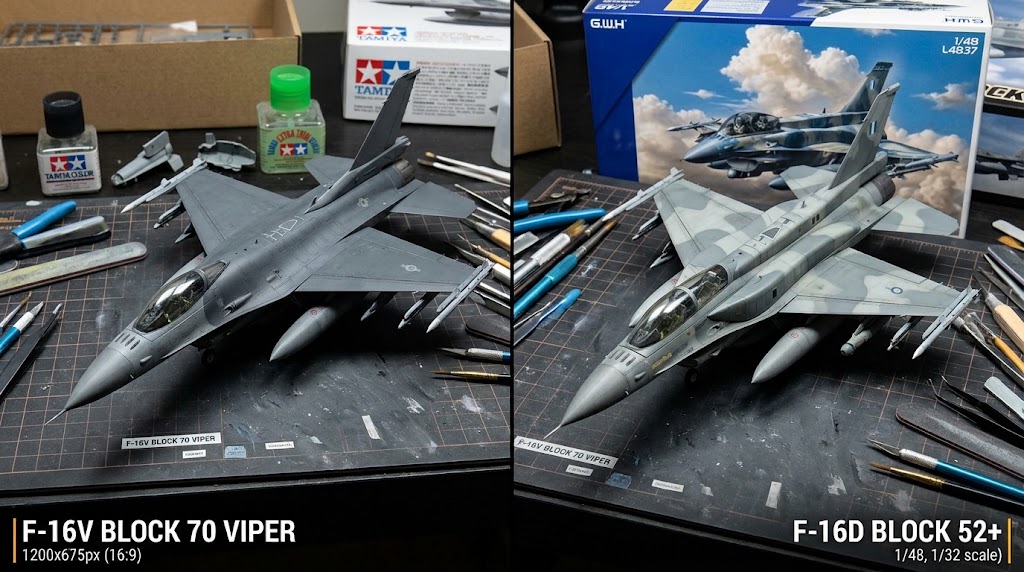
F-16V Block 70 vs. Block 52+: Key Visual Differences & Scale Modeling Guide (2026)
Understanding the exact visual and structural differences in an F-16V Block 70 vs Block 52 comparison is essential for both modern military aviation enthusiasts and scale modelers aiming for competition-grade accuracy. While Lockheed Martin’s fourth-generation Fighting Falcon has retained its iconic blended wing-body silhouette since the late 1970s, the newest Block 70/72 “Viper” configuration—alongside V-upgraded airframes—introduces fifth-generation avionics, structural strengthening plates, and cockpit architecture that set it apart from legacy Block 50/52 and Block 52+ Advanced jets.
Whether you are planning to build the newly announced Great Wall Hobby 1/48 F-16D Block 52+ Export Version (L4837), upgrading a classic quarter-scale Tamiya Viper, or super-detailing an instrument panel with the Reskit 1/32 F-16C Block 50/52 Cockpit Set, knowing how to identify engine intakes, radar radomes, dorsal spines, and cockpit displays is the key to building an authentic modern Viper.
Disclosure: Hobbyzero is reader-supported. When you buy through links on our site, we may earn an affiliate commission at no extra cost to you. As an Amazon Associate, we earn from qualifying purchases.
⚡ Key Takeaways: F-16V Block 70/72 vs. Block 50/52+
- The “0 vs. 2” Engine Rule: Blocks ending in 0 (Block 50, Block 70) use the General Electric F110 engine with the Big Mouth (MCID) intake; Blocks ending in 2 (Block 52+, Block 72) use the Pratt & Whitney F100 engine with the Small Mouth (NSI) intake.
- Cockpit Revolution: The F-16V Block 70 replaces the central analog standby dials between the pilot’s knees with a massive high-resolution 6×8-inch Center Pedestal Display (CPD).
- Radar & Nose Cooling: Block 70 integrates the Northrop Grumman AN/APG-83 SABR AESA radar, accompanied by modified environmental control system (ECS) heat exchangers.
- Airframe Life Extension: Factory-new Block 70/72 airframes feature a 12,000-hour structural service life (50% longer than earlier blocks), heavyweight landing gear, and optional 450-gallon Conformal Fuel Tanks (CFTs).
F-16V Block 70/72 vs. F-16C/D Block 52+: Technical & Modeling Comparison
| Airframe Feature | F-16C/D Block 50 / 52 | F-16C/D Block 52+ Advanced | F-16V Block 70 / 72 (Viper) |
| Primary Radar System | AN/APG-68(V)5 Mechanically Scanned | AN/APG-68(V)9 Pulse-Doppler (SAR mode) | AN/APG-83 SABR Active Electronically Scanned Array (AESA) |
| Cockpit Center Console | Two 4×4″ MFDs + Central Analog Gauges | Color MFDs + Central Analog Instruments | 6×8″ High-Res Center Pedestal Display (CPD) + JHMCS II Helmet |
| Conformal Fuel Tanks (CFT) | Not plumbed on standard USAF jets | Factory plumbed (450-gal upper fuselage tanks) | Factory plumbed (Operator selectable CFTs) |
| Dorsal Avionics Spine | Absent on single-seat C; standard tail on D | Heavy Extended Dorsal Spine on two-seat F-16D | Extended Dorsal Spine on D-models (EW & Chaff/Flare housing) |
| Engine & Intake Pairing | Blk 50: GE F110 (Big Mouth) / Blk 52: PW F100 (Small Mouth) | PW F100-PW-229 + Small Mouth (NSI) Intake | Blk 70: GE F110 (Big Mouth) / Blk 72: PW F100 (Small Mouth) |
| IFF “Bird Slicer” Antennas | Retrofitted on CCIP/Have Glass airframes | Standard 4-blade AIFF forward of canopy | Standard 4-blade AIFF + updated RWR blister fairings |
2026 Best 1/48 & 1/32 Modern F-16 Model Kits & Aftermarket Upgrades
| Model Kit / Upgrade Set | Scale & Item No. | Target Variant | Why It Wins on the Workbench | Check Price |
|---|---|---|---|---|
| Tamiya 1/48 F-16CJ Block 50 Fighting Falcon | 1/48 (#61098) | Block 50 (Base for V-Conversions) | Unmatched fit, slide-molded GE nozzle & metal pitot tube | View on Amazon |
| Kinetic Gold 1/48 F-16C Block 70 / F-16V Viper | 1/48 (#K48102 / Gold) | Block 70 / F-16V | Includes CFTs, Center Pedestal Display cockpit & Sniper ATP pod | View on Amazon |
| Great Wall Hobby 1/48 F-16D Block 52+ Export | 1/48 (#L4837) | Block 52+ Twin-Seater | Next-gen tooling with dorsal spine, CFTs & full air-to-ground ordnance | View on Amazon |
| Tamiya 1/32 F-16CJ Block 50 Fighting Falcon | 1/32 (#60315) | 1/32 Masterpiece | Removable display dolly engine, die-cast landing gear & open M61 Vulcan | View on Amazon |
| Quinta Studio / Reskit 3D Cockpit & Exhaust Upgrades | 1/48 & 1/32 | Block 50/52/70 | 3D-printed CPD screens, ACES II seat harnesses & hollow exhaust petals | View on Amazon |
5 Visual Clues That Separate the F-16V Block 70 from Block 50/52+
When looking at reference photos—or inspecting plastic sprues on your workbench—how can you tell whether an aircraft is a legacy Block 50/52, an export Block 52+, or a brand-new Block 70/72 Viper? Look at these five airframe zones:
1. The “0 vs. 2” Engine Nozzle & Intake Rule
Before checking any antennas, look at the final digit of the block number:
-
Block 50 & Block 70 (Ends in “0”): Powered by the General Electric F110-GE-129 engine. Visually, it features interlocking dark ceramic/metallic carbon-weave exhaust petals and the wider MCID (“Big Mouth”) lower intake duct, where the navigation lights are mounted on the fuselage sides above the intake lip.
-
Block 52+ & Block 72 (Ends in “2”): Powered by the Pratt & Whitney F100-PW-229 engine. It uses shorter, darker metallic turkey-feather exhaust petals with external actuator rods and the narrower NSI (“Small Mouth”) intake.
2. The Cockpit: 6×8-Inch Center Pedestal Display (CPD)
If you peer inside the bubble canopy of a legacy Block 50/52 (or even an early Block 52+), the center pedestal between the pilot’s knees is packed with round mechanical standby gauges and fuel flow indicators. In the F-16V Block 70/72 (and V-retrofitted jets in Taiwan, Greece, and the USAF PoBIT program), that entire lower console is replaced by a massive, vertical 6×8-inch high-resolution color Center Pedestal Display (CPD) that fuses moving-map tactical data with AN/APG-83 AESA radar tracks.
3. Conformal Fuel Tanks (CFTs) & The Dorsal Avionics Spine
Many export Block 52+ and Block 70/72 operators (including Poland, Greece, Singapore, Morocco, Bahrain, Slovakia, and Taiwan) fly with two removable 450-gallon Conformal Fuel Tanks (CFTs) bolted along the upper fuselage wing roots. On two-seat F-16D Block 52+ and Block 70/72 airframes, a muscular Extended Dorsal Spine runs from behind the aft canopy all the way to the vertical stabilizer, housing advanced Electronic Warfare (EW) suites, satellite communications, and extra chaff/flare dispensers.
4. RAM Scab Plates vs. Clean Factory Block 70 Skins
Here is a detail that catches many scale modelers off guard: upgraded F-16A/B/C/D → F-16V conversions often have raised external structural strengthening “scab plates” bolted along the upper wing roots and spine to cure airframe fatigue. However, factory-new Block 70/72 production airframes built in Greenville, South Carolina have all structural reinforcements engineered internally—meaning the outer fuselage skin is smooth and clean!
5. Automated Ground Collision Avoidance (Auto GCAS) & Tail Parachute Housing
Export Block 52+ and Block 70/72 airframes frequently feature an extended rectangular base at the bottom of the vertical tail fin. Depending on the air force, this fairing houses either a brake drag chute (for short/icy runways) or the AN/ALQ-211 / Viper Shield Electronic Warfare suite antennas.
Top 5 F-16V & Block 50/52+ Kits and Upgrades Breakdown (Pros & Cons)
1. Tamiya 1/48 F-16CJ Block 50 Fighting Falcon (#61098) — The Gold Standard Engineering Base
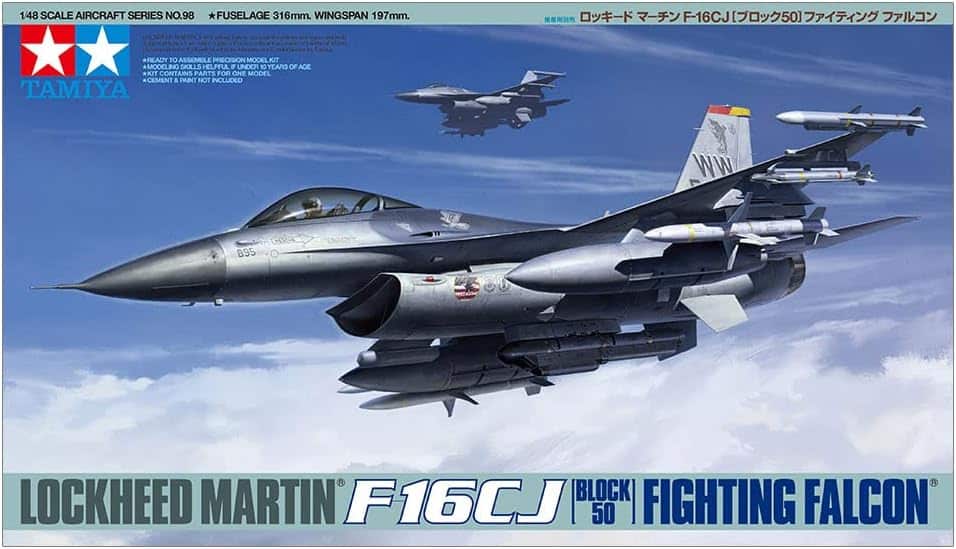
Even decades into the Viper’s history, Tamiya’s 1/48 F-16CJ Block 50 (#61098) is widely considered one of the finest injection-molded aircraft kits ever produced. Featuring internal wing spars that guarantee perfect anhedral/dihedral angles, metal pitot probes, and removable horizontal stabilizers attached via polycaps, it serves as the ultimate stress-free foundation for both standard USAF SEAD Vipers and aftermarket F-16V conversions.
✅ Pros for Scale Modelers:
- Flawless wing-to-fuselage join requires zero putty or heavy sanding around delicate rivets
- Includes both tinted and clear bubble canopies plus a turned metal pitot tube and AOA sensors
- Supported by hundreds of 3D-printed cockpit, exhaust, and CFT conversion sets
❌ Cons to Consider:
- Out of the box, it represents a Block 50 (GE engine) without Conformal Fuel Tanks
- Two-piece upper intake trunking benefits from careful seam smoothing on the inside
2. Kinetic Gold Series 1/48 F-16V / F-16C Block 70 — Best Dedicated Viper Out of the Box
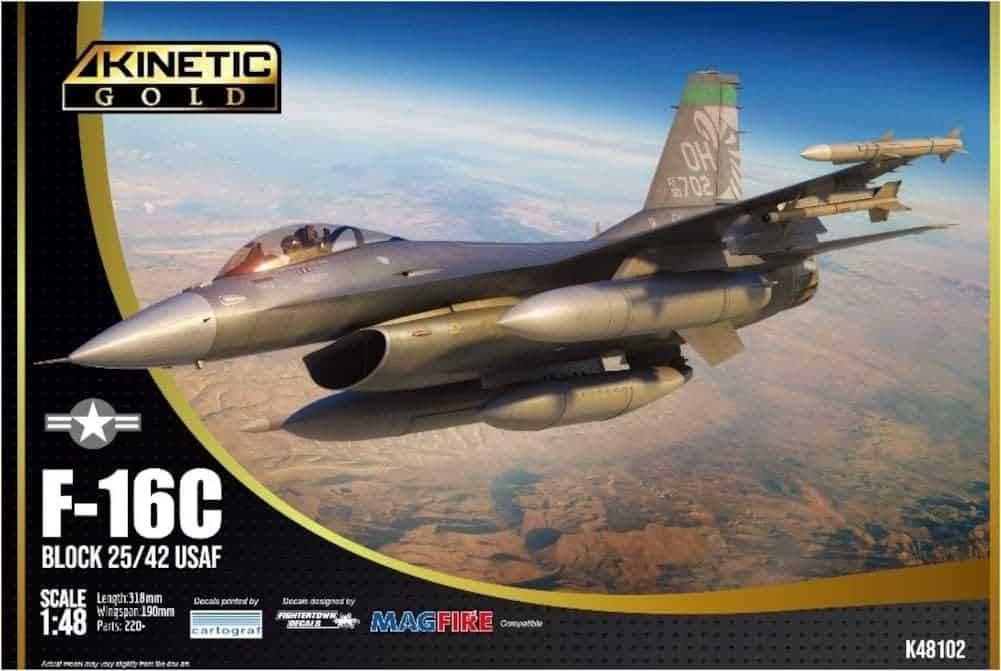
Forget the older first-generation Kinetic kits—the completely re-tooled Kinetic Gold Series 1/48 F-16V & Block 70 lineup features new CAD molds with corrected nose contours and whisper-fine recessed panel lines. If you want to build an out-of-the-box F-16V with the 6×8-inch Center Pedestal Display, AIFF bird-slicer antennas, CFTs, and AN/AAQ-33 Sniper ATP targeting pod without buying separate resin sets, this is your go-to kit.
✅ Pros for Scale Modelers:
- Includes dedicated F-16V / Block 70 instrument panel with the large Center Pedestal Display
- Comes packed with modern weapons sprues (AIM-9X, AIM-120C/D, Sniper Pod, GBU-38 JDAMs)
- Posable leading-edge flaps and flaperons for dynamic parked ramp stances
❌ Cons to Consider:
- Lower intake assembly has multiple joints that require dry-fitting before applying liquid cement
- Instructions occasionally mislabel optional antenna bumps—always cross-check tail number photos
3. Great Wall Hobby 1/48 F-16D Block 52+ Export Version (#L4837) — Ultimate Twin-Seat Strike Viper
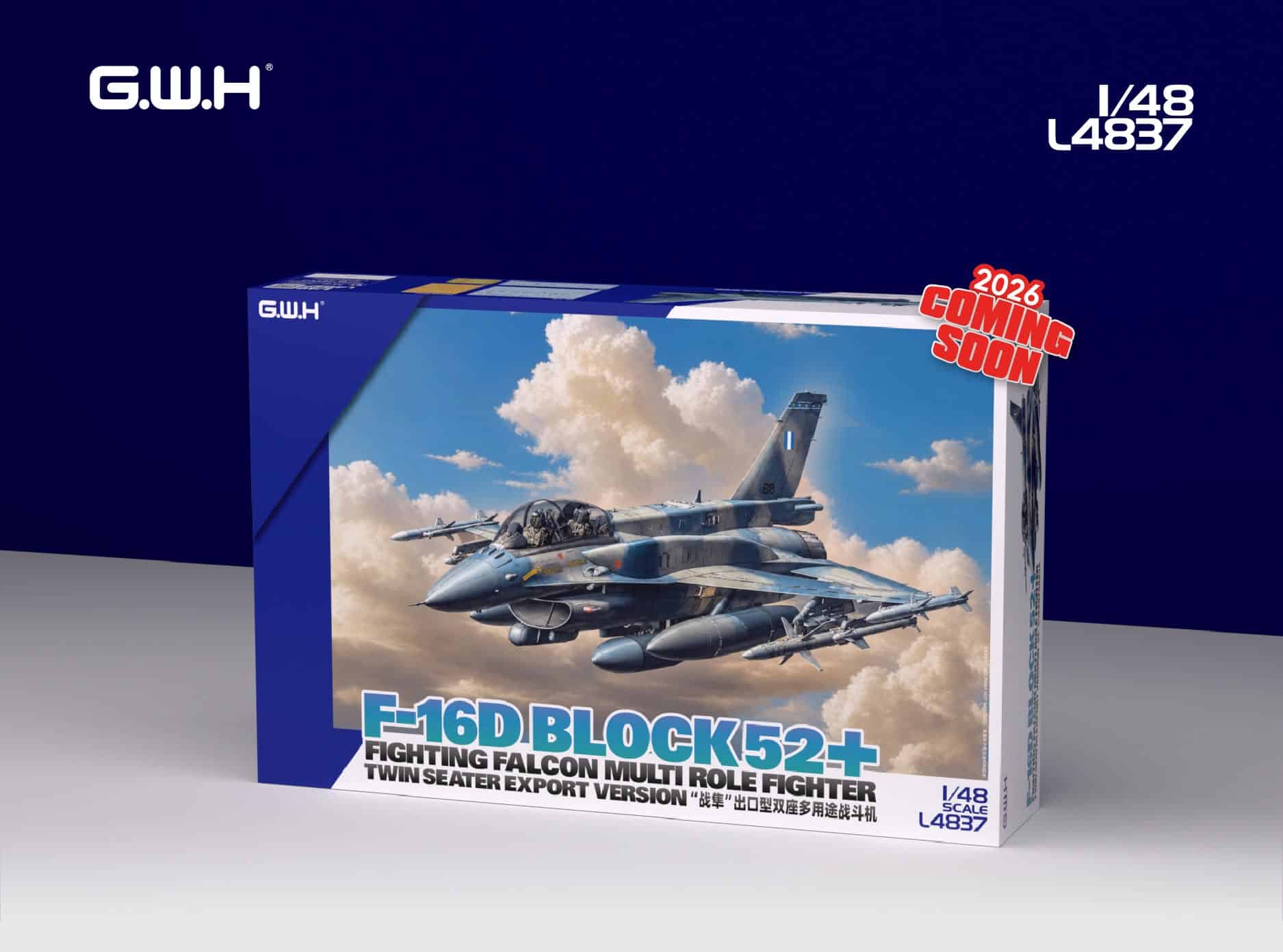
As we detailed in our breaking coverage of the Great Wall Hobby 1/48 F-16D Block 52+ Export Version (L4837), G.W.H has raised the bar for quarter-scale twin-seat Vipers. Combining slide-molded Conformal Fuel Tanks, the heavy export dorsal avionics spine, and one-piece missile bodies, it captures the aggressive “hunched” profile of Polish, Greek, Israeli (Sufa-family), and Singaporean strike Falcons.
✅ Pros for Scale Modelers:
- Exquisite surface riveting on the Extended Dorsal Spine and 450-gallon Conformal Fuel Tanks
- Tandem ACES II cockpit layout with sharp instrument bezels for pilot and WSO
- Slide-molded Pratt & Whitney F100 exhaust nozzle and wheel bays with molded hydraulic lines
❌ Cons to Consider:
- Premium retail price point reflecting its high part count and slide-mold complexity
- Complex multi-tone “Ghost” or desert camo schemes benefit from pre-cut vinyl masks
4. Tamiya 1/32 F-16CJ Block 50 Fighting Falcon (#60315) — The Museum-Grade Showstopper
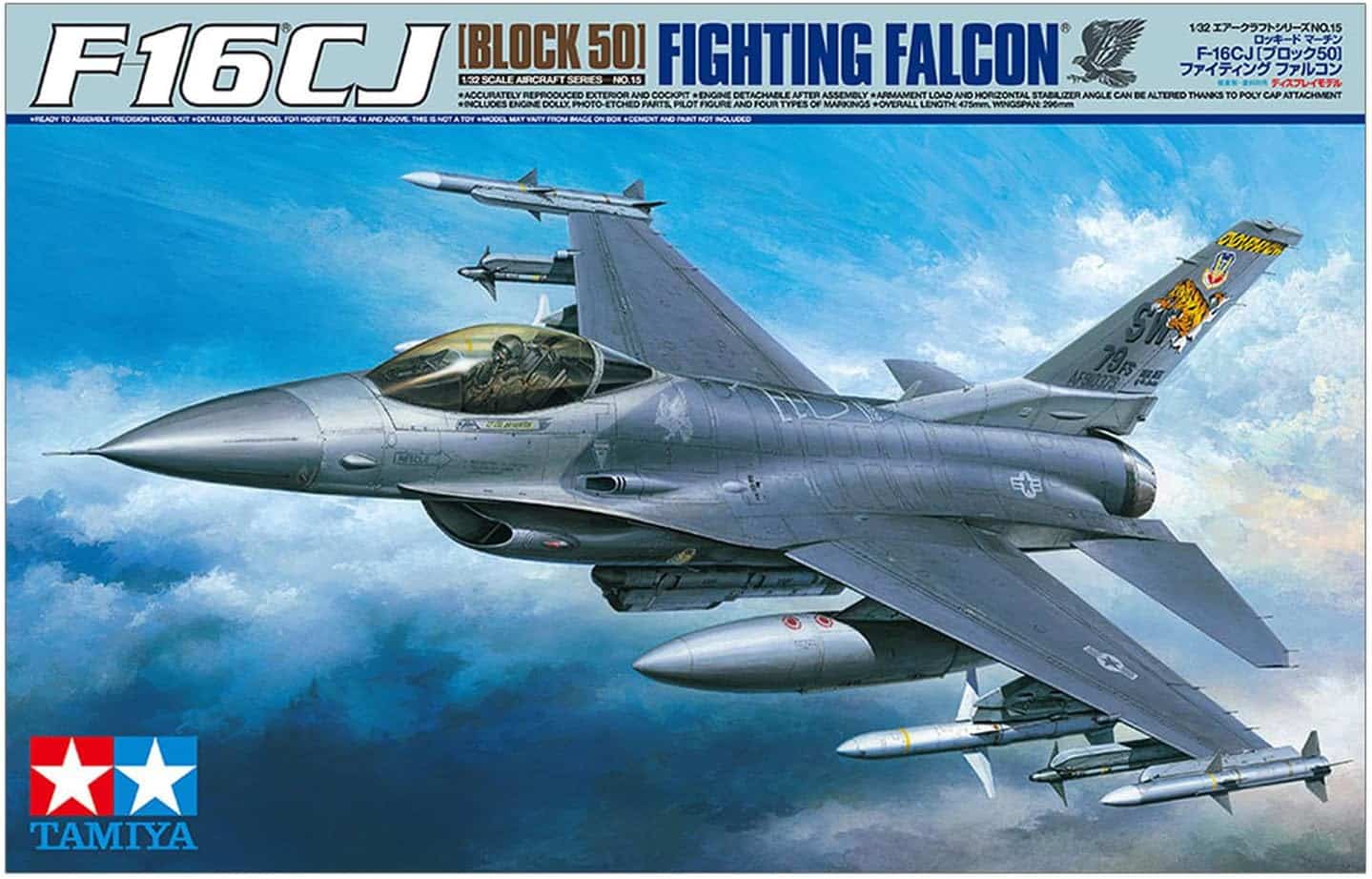
When only a centerpiece 1/32 build will do, Tamiya’s 1/32 F-16CJ Block 50 (#60315) stands in a league of its own. Using die-cast metal landing gear struts to support its substantial weight, real metal screws for structural assembly, and a fully detailed General Electric F110-GE-129 engine that slides out onto a maintenance dolly, it is the ultimate canvas for super-detailing—especially when paired with the upcoming Reskit 1/32 F-16C Block 50/52 3D-Printed Cockpit.
✅ Pros for Scale Modelers:
- Hinged radome opens to reveal a complete AN/APG-68 radar array and M61A1 20mm Vulcan cannon
- Die-cast metal main and nose gear struts prevent plastic sagging over decades of display
- Ordnance attaches via micro polycaps so you can swap missile loadouts after painting
❌ Cons to Consider:
- Central seam running down the tinted/clear bubble canopy must be wet-sanded and polished with compound
- High-investment flagship kit that rewards patience and 40+ hours of bench time
5. Quinta Studio 3D Cockpit Decals & Reskit Exhaust Nozzles — Instant Block 70 / 52+ Realism
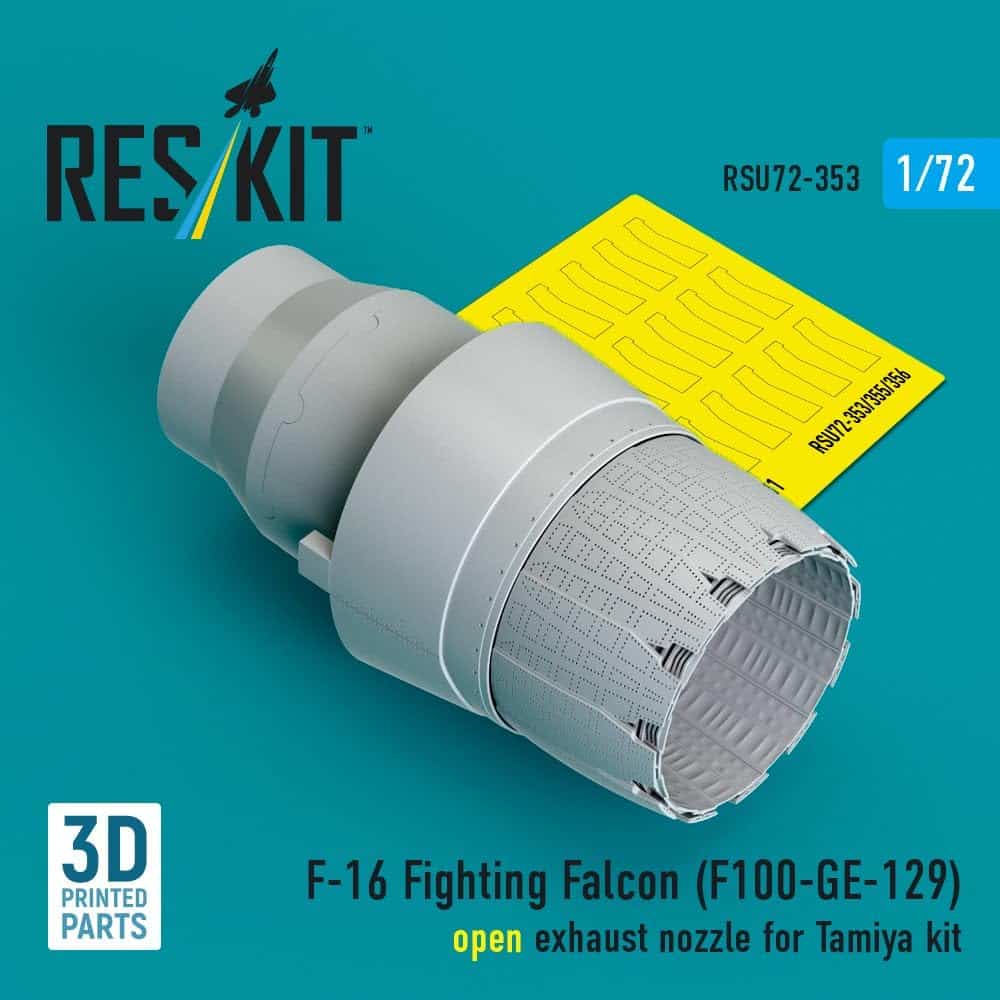
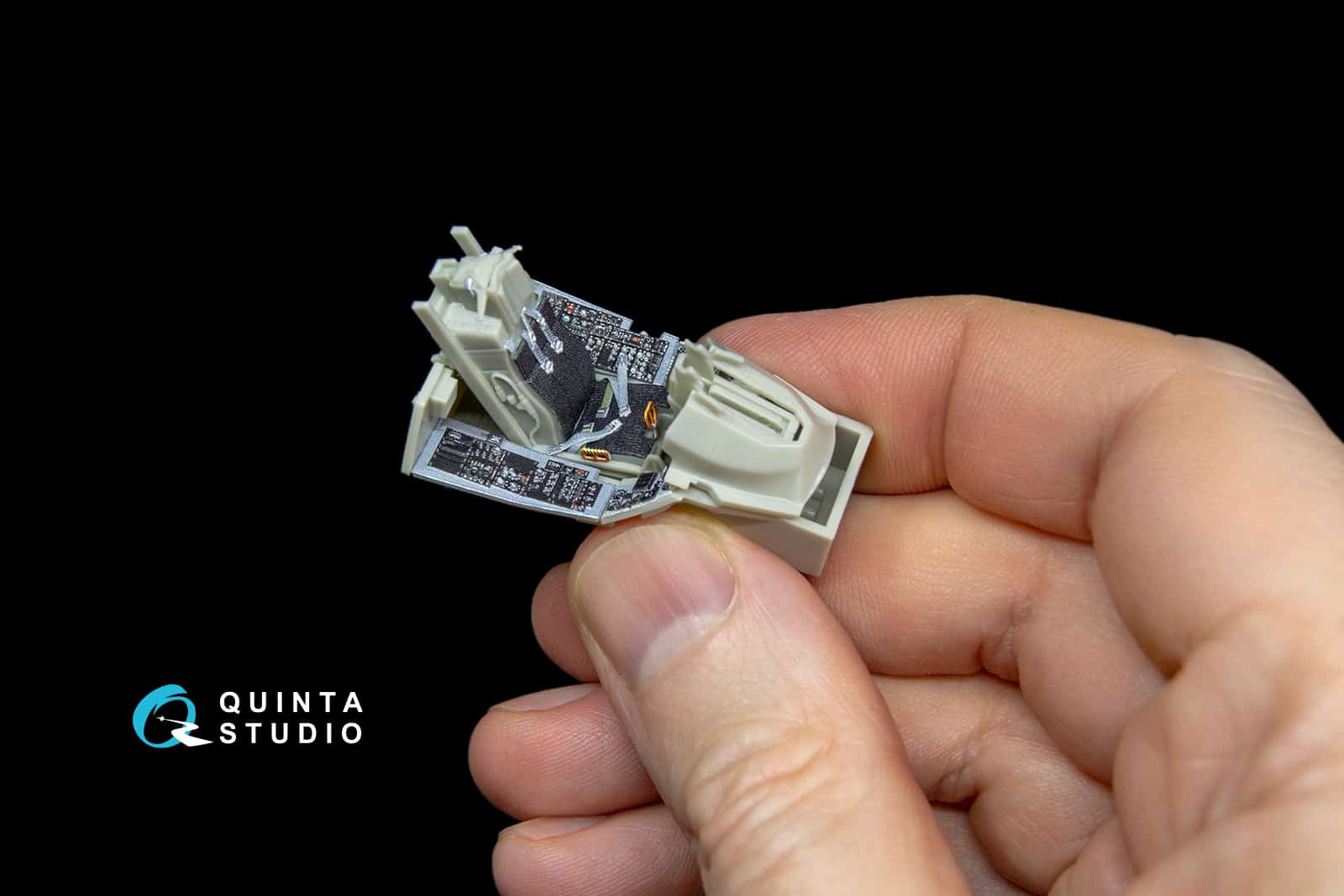
Because the F-16 features a frameless, fishbowl-style bubble canopy, the cockpit is the #1 focal point of the model. Adding Quinta Studio 3D-Printed Interior Decals gives you raised toggle switches, glossy MFD/CPD glass screens, and textured ACES II seatbelts in minutes, while a Reskit 3D-Printed GE F110 or PW F100 Exhaust Nozzle replaces multi-piece plastic petals with razor-thin, hollow-cast perfection.
✅ Pros for Scale Modelers:
- Quinta 3D decals replicate the glowing 6×8″ Block 70 Center Pedestal Display with glassy depth
- Reskit nozzles feature microscopic interior turkey-feather actuation rods with zero mold seams
- Or print your own custom pylons using a machine from our Best Resin 3D Printers for Scale Models Guide
❌ Cons to Consider:
- 3D cockpit decals must be secured with a tiny drop of PVA white glue or Ultra Glue (never use hot solvent decal softener!)
- Verify whether your kit is Tamiya, Kinetic, or G.W.H before ordering—resin exhaust rings are kit-specific
How to Paint the Modern F-16 “Have Glass V” Metallic Sheen
If you look at modern USAF Block 50s or newly delivered Block 70/72 Vipers under sunlight, they no longer wear the classic two-tone Ghost Grey scheme (FS 36118 Gunship Grey over FS 36270 Neutral Grey) in a dead-flat finish. Instead, modern Vipers are coated in Have Glass V, a ferromagnetic radar-absorbent paint infused with microscopic metallic flakes that shift from dark pewter grey to gritty olive-bronze as it weathers.
Here is the foolproof 3-step workbench recipe to replicate Have Glass V in 1/48 or 1/32 scale:
-
Black-Basing & Marbling: Prime the airframe in black and marble the panels using the directional airbrush techniques from our Slapchop vs Zenithal Highlighting Guide.
-
The Metallic Grey Basecoat: Mix 85% FS 36118 (Gunship Grey) + 15% Fine Silver or Steel Metallic Acrylic (or use dedicated MRP-279 / Hataka Have Glass Grey). If you are new to thinning metallic and matte acrylics, review our Painting Models with Acrylic Paint Beginner’s Guide.
-
Panel Lining & Semi-Matte Seal: Seal with gloss clear, apply a dark grey/brown pin wash following our Safe Panel Lining Guide, and finish with a Satin / Semi-Matte Varnish mixed with one drop of clear pearl so the metallic radar-absorbent sheen stays alive!
🛠️ Essential Viper Builder’s Toolkit (Canopy Seam & Paint Prep)
Every modern F-16 kit has a molded omega-crosssection seam running straight down the center of the clear bubble canopy. Polish it crystal clear and nail your USAF/NATO grey paintwork with these four essentials:
- 🔹 Erase Clear Canopy Mold Seams: Tamiya Polishing Compound Trio (Coarse, Fine & Finish) — After wet-sanding the canopy seam with 3000–8000 grit sponges, this trio restores factory optical clarity.
- 🔹 Fog-Free Canopy & 3D Decal Bonding: Ammo by Mig Ultra Glue (Acrylic Water-Based) — Bonds clear bubble canopies, photo-etch HUD frames, and 3D cockpit decals with zero white CA fumes.
- 🔹 Authentic USAF / NATO Viper Greys: Vallejo Model Air Modern USAF Grey Paint Set — Pre-thinned FS 36118, FS 36270, and FS 36375 airbrush colors matched to F-16 C/D/V schemes.
- 🔹 Radome & Exhaust Masking Precision: Eduard / New Ware Die-Cut Kabuki Canopy & Wheel Masks — Saves hours of masking around the compound curves of the Viper canopy and static dischargers.
Frequently Asked Questions (FAQ)
Can I convert a 1/48 Tamiya F-16CJ Block 50 into an F-16V Block 70?
Yes! Because both the Block 50 and Block 70 use the General Electric F110 engine and the “Big Mouth” (MCID) intake, Tamiya’s 1/48 F-16CJ (#61098) is the easiest starting point for a Block 70 conversion. You simply need to add an aftermarket 3D-printed Block 70 cockpit instrument panel (with the 6×8″ Center Pedestal Display), AIFF “bird slicer” nose antennas, updated wingtip LAU-129 launchers, and optional Conformal Fuel Tanks if your target air force uses them.
Do all F-16V Block 70 and Block 72 jets wear Conformal Fuel Tanks (CFTs)?
No. While all factory-new Block 70/72 airframes are internally plumbed to carry 450-gallon Conformal Fuel Tanks, CFTs can be bolted on or removed by ground crews in a few hours. Operators like Bahrain, Slovakia, Greece, and Poland frequently fly with CFTs attached, whereas Taiwanese (ROCAF) F-16V Block 20/70 jets typically fly clean without CFTs to maximize dogfighting agility.
Why are F-16 canopies tinted gold or smoke, and how do I paint them?
Modern F-16 bubble canopies are coated with a microscopic layer of Indium Tin Oxide (ITO) gold film to reflect enemy radar waves away from the metal ACES II ejection seat inside—reducing the jet’s frontal radar cross-section (RCS). To replicate this on a clear model canopy, airbrush an ultra-thin mist of 90% Clear Gloss Varnish + 7% Tamiya X-19 Smoke + 3% Tamiya X-24 Clear Yellow on the inside of the canopy.
